The Same Seven Mistakes, Every Company, Every Decade
What 500 FDA enforcement actions reveal about how organizations think. The same seven failure patterns appear across medical device companies, decade after decade. The root cause is not poor procedures. It is cognitive biases that evolved for small-group survival but break down in modern industrial settings.
TL;DR
Five hundred FDA enforcement actions cluster into seven failure patterns that have stayed the same for decades. The patterns persist because they come from cognitive biases wired into human brains for small-group survival, not from missing procedures. Writing better CAPA processes does not fix the problem. The solution requires a cognitive layer that does not share human evolutionary biases.
The Same Seven Mistakes, Every Company, Every Decade
What 500 FDA Enforcement Actions Reveal About How Organizations Think
The Data
The FDA’s device enforcement database contains thousands of active recalls, Warning Letters, and formal actions against medical device manufacturers. If you pull 500 of them and read the reasons, a striking pattern emerges.
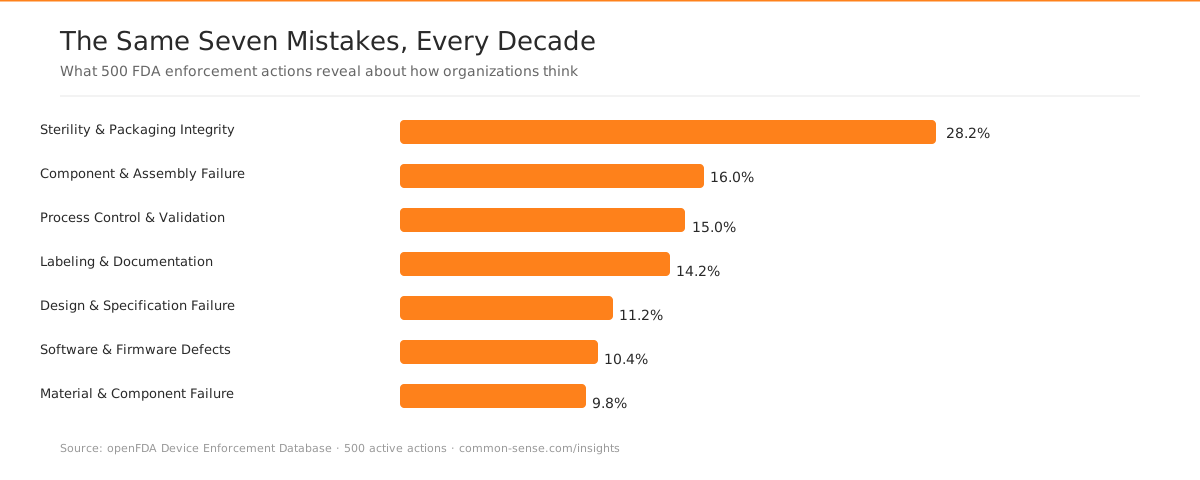
The failures don’t scatter randomly across the landscape of possible errors. They cluster into seven distinct categories, accounting for nearly 90% of all enforcement actions:
| Pattern | Frequency | Class I (Critical) |
|---|---|---|
| Sterility & Packaging Integrity | 28.2% | 8 |
| Component & Assembly Failure | 16.0% | 6 |
| Process Control & Validation | 15.0% | 4 |
| Labeling & Documentation | 14.2% | 0 |
| Design & Specification Failure | 11.2% | 2 |
| Software & Firmware Defects | 10.4% | 12 |
| Material & Component Failure | 9.8% | 5 |
Class I recalls are for devices that could cause serious harm or death. Labeling errors account for 14.2% of enforcement actions because they are common, but they rarely reach that threshold. Wrong instructions or missing warnings are regulatory violations, not immediate patient threats. Software defects are less frequent overall but produce the most Class I recalls, because a firmware failure in an insulin pump or pacemaker is immediately life-threatening.
Notice something: these seven categories have been essentially unchanged for decades. The FDA has been issuing enforcement actions since the Medical Device Amendments of 1976. The products have changed dramatically, from mechanical pacemakers to closed-loop insulin delivery systems to AI-assisted surgical robots. The materials have changed. The manufacturing processes have changed. The regulatory requirements have changed.
The failure patterns haven’t.
The Shallow Explanation
The standard explanation is procedural: these companies didn’t follow their own procedures.
It’s true but useless. Everyone knows companies should follow procedures. The question is why they consistently aren’t, across companies that have completely different products, cultures, leadership teams, and industry sectors.
A cardiac rhythm device company in New Jersey and an orthopedic implant company in Florida and a diabetes technology company in California all get hit with the same categories of violations. They don’t share suppliers. They don’t share employees. They don’t share regulatory inspectors.
They share something else: they share a human operating system that evolved for a world that no longer exists.
The Deep Explanation
Human brains evolved over millions of years to optimize for small-group survival in stable environments. The cognitive heuristics that kept our ancestors alive are wired into how we think, decide, and organize. In a tribe of 150 people, these heuristics worked beautifully.
Modern medical device development requires cross-functional alignment across teams of hundreds, with feedback loops measured in months, under regulatory constraints that didn’t exist until last century. The environment changed. The operating system didn’t.
Here’s what that looks like in practice:
Local Optimization (35.6% of enforcement actions)
The evolutionary logic: In a small group, optimizing your own task maximized group survival. If you were the best hunter, hunting more was good for everyone. There was no separation between individual and collective outcome.
The modern breakdown: In a complex organization, optimizing your own department actively harms system quality. The line operator who skips a seal check to hit throughput targets is behaving exactly as evolution trained them to behave. They’re optimizing their local metric (units per hour) and have no evolutionary wiring to understand that this destroys the system metric (sterility assurance).
What the FDA sees: Sterility failures, packaging defects, assembly errors, inadequate in-process controls. These are the #1 and #2 most common enforcement categories, together accounting for 44% of all actions.
Recency Bias
The evolutionary logic: Recent events were the best predictor of immediate danger. A predator seen today matters more than one seen last month. Your brain weights recent experience heavily because, for most of human history, that was rational.
The modern breakdown: In quality systems, recent clean inspections create false confidence. A facility that passed last quarter’s audit treats the next quarter’s deviations as anomalies, not patterns. Statistical thinking requires equal weighting of all data points, the opposite of how human brains evolved.
What the FDA sees: Inadequate trend analysis, failure to analyze complaint data, CAPA based on isolated incidents, environmental monitoring gaps. The company that gets a Warning Letter for “failure to analyze complaint data” isn’t lazy, it’s suffering from the same recency bias that made your ancestors run from smoke.
Pattern Completion (Automation Bias)
The evolutionary logic: Rapid pattern recognition saved lives. If something looks like a predator, run, don’t analyze. The brain fills in expected patterns automatically. This is the same mechanism that makes you misread familiar text.
The modern breakdown: When 99% of units follow the same path, the brain auto-completes the exception. Labeling errors, wrong-component assembly, and missed deviations all stem from the brain seeing what it expects rather than what is present.
What the FDA sees: Labeling errors (14.2% of all enforcement actions), wrong component installation, documentation errors, visual inspection failures.
Authority Deference
The evolutionary logic: Deferring to the group leader was survival. Questioning the chief’s hunting plan could mean being excluded from the group, and death.
The modern breakdown: Engineers don’t challenge program managers’ timelines. Technicians follow shift supervisors’ verbal instructions over written SOPs. Quality findings get escalated and then quietly deprioritized by leadership focused on delivery. The hierarchy that kept tribes alive now suppresses the upward flow of quality information.
What the FDA sees: SOP deviations approved by management, inadequate management review, resource allocation conflicts, design changes without full validation.
Planning Fallacy (Optimism Bias)
The evolutionary logic: Confidence was rewarded in tribal settings. The hunter who said “I’ll definitely bring down that elk” got the group to follow. Pessimism was socially punished.
The modern breakdown: Engineers consistently underestimate software complexity, validation effort, and defect rates. Every embedded systems project runs late because the team planned for the best case. In medical devices, this means design changes ship without adequate testing, and validation protocols are compressed to meet deadlines.
What the FDA sees: Inadequate software validation, design control failures, insufficient testing, protocol deviations. Notably, software/firmware defects account for 12 Class I (critical) recalls, the highest of any category. The stakes for optimism bias are lethal. I wrote a deeper look at this pattern in Why Software Defects Kill.
Conflict Avoidance
The evolutionary logic: Group cohesion was survival. Direct confrontation risked exile. Problems were smoothed over, not confronted.
The modern breakdown: CAPA systems rot because no one wants to be the person who flags a systemic problem. Complaint data sits unanalyzed because analyzing it would require confronting the engineering team about a design flaw. The same dynamic that kept tribes peaceful now allows quality problems to accumulate until the FDA shows up.
What the FDA sees: Inadequate CAPA, complaint data not analyzed, failure to investigate root cause, corrective actions not implemented. This is the pattern that appears in almost every Warning Letter, because it’s the pattern that prevents all other patterns from being fixed. I explore this dynamic in more detail in Why CAPA Systems Rot.
Sunk Cost Escalation
The evolutionary logic: Abandoning a hunt meant starvation. Once resources were committed, doubling down was rational, turning back wasted the investment and guaranteed no food.
The modern breakdown: Once a design architecture is chosen, teams accumulate evidence of its problems but keep iterating instead of pivoting. A flawed firmware architecture gets patch after patch instead of being redesigned. The FDA sees this as “inadequate design controls”, but it’s really sunk cost escalation wearing an engineering disguise.
What the FDA sees: Design control failures, inadequate design verification, repeated field failures of the same component, engineering change orders that don’t address root cause.
Why Procedural Fixes Fail
You can write a better CAPA procedure all day. If the underlying dynamic is that no one wants to be the person who flags a problem (conflict avoidance), the procedure becomes paperwork theater. Everyone fills out the forms. No one addresses the root cause. The FDA shows up six months later and cites the same violations.
This is why the same seven patterns appear, decade after decade, across companies that have completely different products, cultures, and leadership. The regulatory environment changed. The human operating system didn’t.
Procedural fixes address the symptoms. They don’t address the cognitive root causes. And because the root causes are wired into how human brains work, they’re remarkably resistant to procedural intervention.
The Path Forward
There is a way out. It doesn’t require changing human nature. It requires introducing a cognitive layer into the organization that doesn’t have the same biases.
An AI-assisted constraint diagnosis has no tribal loyalty to Engineering over Quality. It has no recency bias that makes last week’s fire feel more important than six months of accumulating complaint data. It has no authority deference that silences upward flow of quality information. It has no conflict avoidance that lets CAPA systems rot.
The point is to use machines to see what humans can’t see, because humans are wired to not see it. The constraint is a cognitive one. And the solution requires a cognitive tool that operates outside the evolutionary wiring that created the problem. We’ve seen this work in practice: AI-assisted Evaporating Clouds can surface the hidden assumptions that keep teams stuck in blind spots.
The companies that figure this out won’t just avoid FDA enforcement actions. They’ll build organizations that actually work because they’ll finally be addressing the real constraints instead of the symptoms.
This analysis is based on 500 active FDA device enforcement actions retrieved from the openFDA API. The pattern categorization and cognitive driver mapping represent the author’s interpretation of the data.
If you are looking at a specific quality system in your organization and aren’t sure whether the problem is procedural or cognitive, send me a note at john@common-sense.com. I am happy to help you sanity-check your thinking.