Where Does the Money Come From?
A public hospital loses tens of millions a year. Taxpayers cover the gap. But where does the taxpayers' money come from? Following that thread leads to a reframe that might change the conversation.
TL;DR
A public hospital’s operating loss is covered by taxpayer levies. But taxpayers can only pay from their own surplus, the gap between what they earn and what they spend. That gap is profit. The institution runs on it. The real question is not whether profit is acceptable but whether the system generates enough surplus for everyone it serves, and whether that surplus gets allocated without creating losers.
Last night I sat in the back row of a public hospital board meeting in the Pacific Northwest. A group of union members had come to speak during public comment. This is not unusual. Groups with something to say show up, say it, and the board listens. It’s how public governance is supposed to work, and everyone in the room handled it well. The union members were respectful and clear. The board and executive staff listened carefully. That part was not the problem.
But something about the evening stuck with me. Not anything that was said, exactly. More the shape of the conversation. There was a familiar undercurrent: this is a non-profit hospital, and therefore the people who run it should behave differently than if it were a for-profit enterprise. The workers’ interests should come first, or at least ahead of financial concerns, because this institution exists to serve the community, not to make money.
I’ve watched this dynamic play out at many board meetings over the past six months. And I think there’s an error in it that’s worth examining.
This hospital operates at a loss. The gap between what it earns from patient care and what it spends to deliver that care runs to tens of millions of dollars a year. The difference is made up by taxpayers through the public hospital district levy. That’s the design. It’s legal, it’s transparent, and it keeps the doors open.
Here is the question I want to ask: Where does that tax money come from?
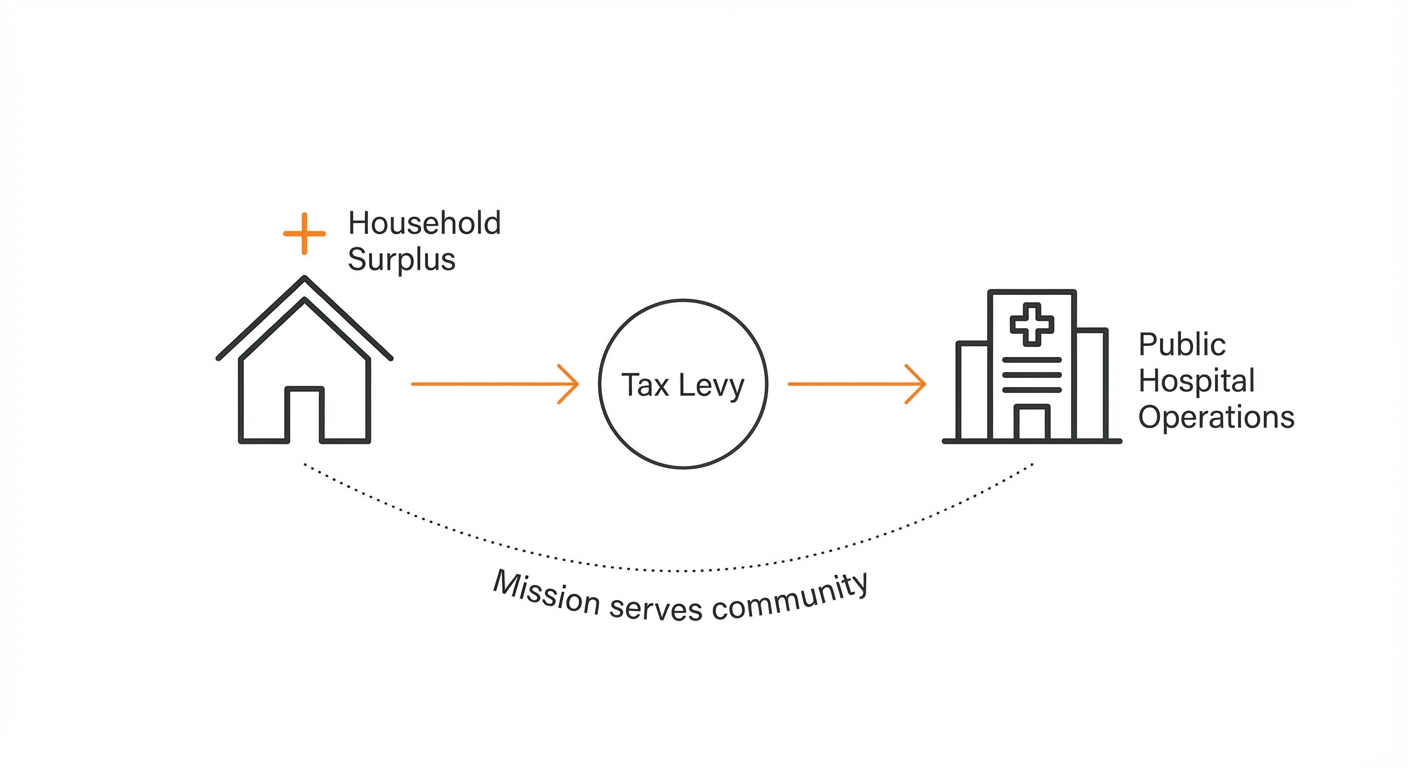
It comes from the residents of the district. They pay property taxes, and a portion flows to the hospital. But those residents can only pay taxes on money they didn’t need for something else. The tax comes from the gap between what each household earns and what it must spend on its own needs.
That gap has a name. It’s called profit. Or surplus, if you prefer the word. The nurse who works at this hospital and pays property taxes that fund the levy can only do so because her household earns more than it spends. Her surplus keeps the doors open.
So when profit gets treated as a dirty word, as something that taints the motives of anyone associated with it, I find myself confused. The institution that people want to protect from the influence of profit is itself funded by profit. Not by corporate profit, but by thousands of small household surpluses accumulated across a tax district. The mechanism is the same. Someone produced more value than they consumed, and the excess was redirected to a shared purpose.
I am not making a political argument here. I’m making a structural observation. Every sustainable system, whether it files taxes as a non-profit or a for-profit, must generate more value than it consumes. When it doesn’t, someone else has to cover the gap. And whoever covers the gap can only do so from their own surplus.
A hospital that loses tens of millions a year is not in a virtuous position. It’s in a dependent one. That dependency isn’t shameful; the community chose to create this institution and chose to fund it through taxes. But it means the hospital’s ability to fulfill its mission is contingent on the economic health of the people it serves. If their surpluses shrink, so does the hospital’s lifeline.
This is where the real conversation should be, I think. Not “is profit good or bad?” but “is this system generating enough surplus for everyone it’s supposed to serve?” That question includes the workers. It includes the patients. It includes the taxpayers. And it includes the institution itself, which needs operating surplus to fund equipment, attract talent, and invest in the future without going back to the tax base for every dollar.
When union members show up at a board meeting, they are making a claim on surplus. They want more of it directed toward compensation and working conditions. That is not an illegitimate claim. But notice: they are not arguing against surplus. They are arguing about how it gets allocated. Everyone in the room, workers, administrators, commissioners, taxpayers, implicitly agrees that surplus must exist. The disagreement is over distribution.
Framing it as “people vs. profit” obscures this. It turns a design question into a moral argument. And moral arguments, in my experience, tend to produce heat rather than solutions.
There’s a principle I come back to often in my work: any solution that creates losers is wrong in some way. Not wrong because it’s immoral, necessarily, but wrong the way an engineering design is wrong when it produces an unacceptable output. The fix isn’t outrage. The fix is better design.
A public hospital that can’t generate operating surplus is a system producing an unacceptable output. Workers who can’t earn a living wage at that hospital: same thing. Taxpayers whose levies keep climbing while services stagnate: same thing. These aren’t competing moral claims. They’re symptoms of a system that hasn’t yet been fully debugged.
The word “non-profit” describes a tax filing status. It does not describe a moral state. And the word “profit” describes a structural condition, the existence of surplus, without which nothing in the system works. Not the hospital. Not the tax base. Not the paychecks.
If we could set down the moral framing long enough to look at the engineering, I think we’d find more room to move than anyone currently believes.
I could be wrong about this. If you see it differently, I’d welcome the conversation. You can reach me at john@common-sense.com.