The Compass and the Toolkit: Why Healthcare Needs Both TOC and Lean
Healthcare has adopted Lean almost exclusively for process improvement, but the Theory of Constraints answers the question Lean cannot: where should you focus? Using both together produces dramatically better results.
TL;DR
Healthcare relies almost exclusively on Lean for process improvement, but Lean answers “where is waste?” while the Theory of Constraints answers “what limits throughput?” A systematic review of 42 TOC implementations in healthcare found 50% mean reductions in wait times and 34% increases in throughput. Using TOC as the strategic compass and Lean as the tactical toolkit produces results roughly an order of magnitude better than either alone.
An ophthalmologist in Portugal had a problem familiar to anyone who has worked in healthcare: too many patients waiting, not enough throughput, and a growing sense that the system was working against everyone in it. He did not hire a consulting firm. He did not launch a multi-year transformation initiative. He applied the Theory of Constraints’ five focusing steps, identified the actual bottleneck in his imaging practice, reorganized the workflow around it, and improved patient throughput by 64% in a matter of weeks. The cost was essentially nothing. (A candid footnote: the improvement was not sustained after the doctor who championed it left the organization. That fact is itself instructive, and we will return to it.)
That result is not an anomaly. A systematic review of 42 TOC implementations in healthcare, published in the journal Health Systems, found that every single one reported positive outcomes. The mean results across those studies were striking: 50% reductions in patient waiting time, 38% reductions in length of stay, 43% increases in operating room productivity, and 34% increases in overall throughput.
So why has almost no one in hospital leadership heard of the Theory of Constraints?
Two Frameworks, Two Questions
Healthcare’s dominant process improvement methodology is Lean, adapted from the Toyota Production System. Lean asks: Where is waste? It provides a disciplined set of tools for finding and eliminating non-value-adding steps in a process. Value Stream Mapping, 5S, standardized work, kaizen events, A3 problem solving. These are good tools. In the right context, they produce real results.
The Theory of Constraints, developed by physicist Eli Goldratt and introduced in his 1984 novel The Goal, asks a different question: What is limiting throughput? Rather than improving processes broadly, TOC identifies the single point in a system that governs overall performance, the constraint, and focuses all improvement effort there. Everything else is subordinated to protecting and maximizing that constraint.
These are not competing philosophies. They answer different questions. The problem is that healthcare has embraced one and largely ignored the other, and the one it ignores is the one that tells you where to aim.
What Lean Does Well
Lean excels at process-level improvement. If you know your emergency department triage process is full of redundant steps, Lean will help you map it, identify the waste, and redesign it. If your surgical instrument sterilization workflow has unnecessary transport and waiting, Lean’s tools will find and fix that. These are genuine improvements, and hospitals that apply Lean tools with discipline see real gains in specific areas.
But there is a pattern worth noticing. The most common Lean implementations in healthcare are 5S workplace organization, Value Stream Mapping workshops, and localized kaizen events. These are fragments of the Lean system, not the system itself. Practitioners of what Bob Emiliani calls “Real Lean” would recognize that most hospital implementations barely scratch the surface of what Toyota actually does.
The evidence reflects this gap. A review in the Journal of Healthcare Engineering reports that researchers have estimated 70% of Lean projects fail in healthcare organizations, with full deployment of Lean principles reported in as few as 4% of U.S. hospitals. Across all industries, an Industry Week survey found that roughly 70% of plants using Lean achieved only 2% of their objectives. A province-wide Lean transformation in Saskatchewan, one of the largest ever attempted in healthcare, showed no statistically significant improvement in patient satisfaction across care centers.
These are not arguments against Lean. They are arguments against partial Lean, against adopting the tools without understanding the system they belong to. And they point toward a deeper problem: even well-executed Lean can improve the wrong things.
The Problem Lean Cannot Solve
Consider a hospital where the emergency department has been Lean-optimized. Triage is faster. Patient flow through assessment is smoother. Throughput in the ED has improved. But patients are now boarding in ED hallways for hours because there are no inpatient beds available. The constraint is downstream, in discharge, in post-acute placement, in the policies and staffing patterns that determine how quickly beds turn over.
In this scenario, the ED improvement does not help the patient. It moves people more efficiently into a queue that cannot clear. The system’s throughput has not changed. Only the location of the waiting has shifted.
Lean does not have a built-in mechanism for asking, “Should we even be working on this process?” Its orientation is to improve whatever process you are looking at. TOC’s orientation is different: find the constraint first, then decide where to invest your improvement effort.
This distinction matters enormously in healthcare, where resources for improvement are limited, staff are already stretched, and every kaizen event or Lean project competes for the same finite pool of attention and energy. Spending six months optimizing a non-constraint process is not just unproductive. It is demoralizing to the people involved when nothing meaningfully changes for patients.
What TOC Brings That Lean Lacks
The Theory of Constraints contributes three things that Lean’s toolkit does not provide.
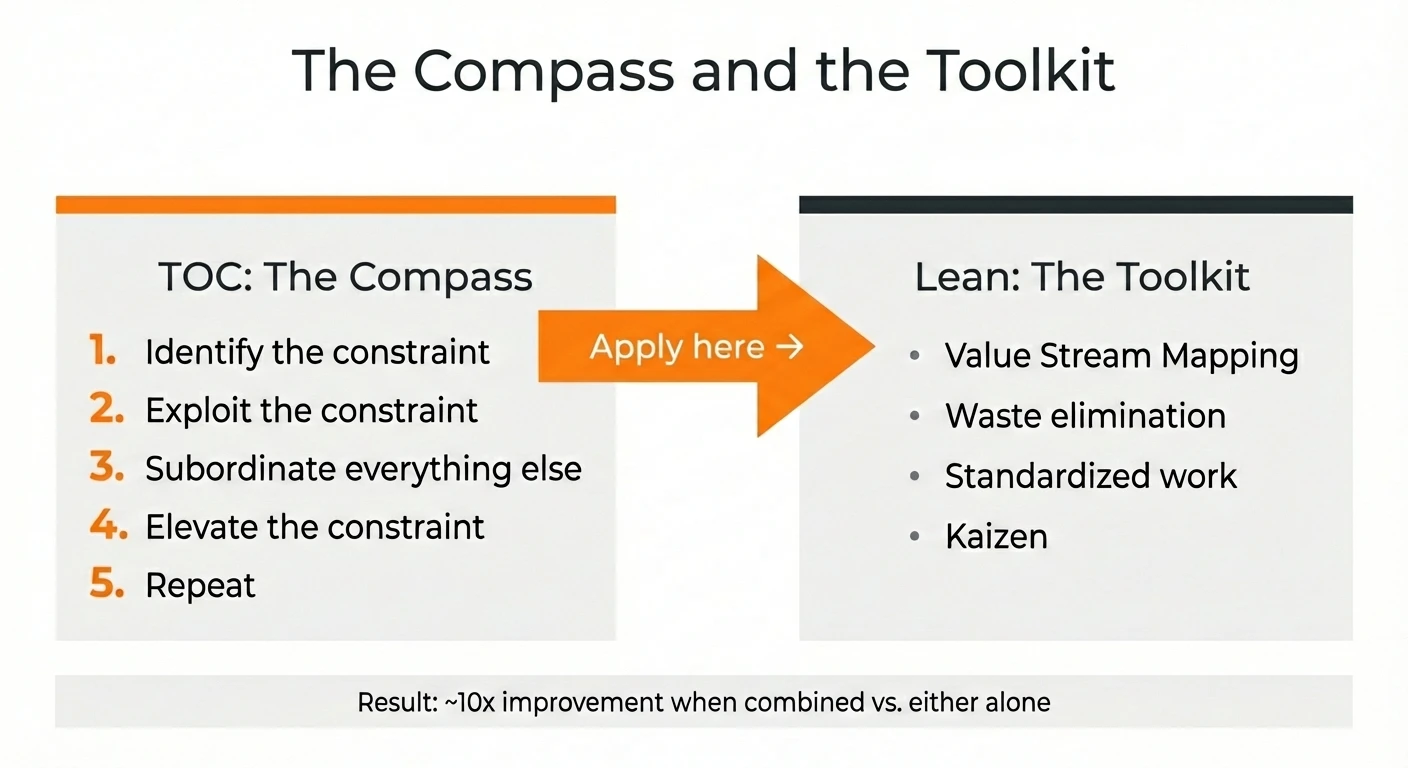
First, focus. The five focusing steps (identify the constraint, exploit it, subordinate everything else to it, elevate it if necessary, then repeat) give an organization a sequence. They answer “what should we work on next?” before anyone picks up a Lean tool. In the ophthalmology case, this sequence led the doctor to realize that the constraint was not where he assumed it would be. His initial guess was wrong. The focusing steps corrected it in days, not months.
Second, conflict resolution. TOC includes a set of thinking tools, most notably the Evaporating Cloud, that surface the hidden assumptions behind organizational conflicts. Lean has root cause analysis (5 Whys, fishbone diagrams), but these assume a single causal chain. Healthcare problems frequently involve competing legitimate requirements: the need for thorough documentation versus the need for fast patient throughput, the need for specialist availability versus the need for schedule flexibility. The Evaporating Cloud makes these conflicts explicit and identifies the assumptions that can be challenged. Lean has no equivalent.
Third, system-level thinking about throughput. TOC measures success in terms of throughput (the rate at which the system generates its goal), not in terms of local efficiency. This prevents the optimization trap where every department looks efficient on paper while the system as a whole underperforms. Lean’s emphasis on eliminating waste can, if applied without system-level guidance, encourage exactly this kind of local optimization.
The Compass and the Toolkit
A useful way to think about the relationship: TOC is the compass, Lean is the toolkit.
The compass tells you where to go. It identifies the constraint, determines the direction of improvement, and prevents you from expending effort in places that will not move the needle. The toolkit gives you the means to make improvements once you know where to apply them. Value Stream Mapping at the constraint. Waste elimination at the constraint. Standardized work at the constraint.
This is not a theoretical distinction. A published case study documents a two-year experiment across 21 plants at a California corporation. Eleven plants used Six Sigma alone, four used Lean alone, and six used TOC as the strategic framework with Lean and Six Sigma applied within it. The six TOC-led plants generated 89% of the total cost savings across all 21 plants. The eleven Six Sigma plants generated 7%. The four Lean plants generated 4%. The study was conducted and published by practitioners rather than academic researchers, but the scale and duration of the experiment make it difficult to dismiss.
Those numbers deserve a moment of reflection. The plants that knew where to focus their Lean and Six Sigma efforts outperformed the plants that applied those same tools without strategic direction by roughly an order of magnitude.
Why Healthcare Chose Lean (and Missed TOC)
The history is partly institutional. Virginia Mason Medical Center’s high-profile adoption of the Toyota Production System in the early 2000s created a template that other health systems followed. The “eliminate waste” framing is also politically comfortable. It sounds like good stewardship. No one objects to reducing waste.
“Find your constraint” requires something harder. It requires admitting that your system has a chokepoint, that not all parts of the organization are equally important to overall performance, and that some departments may need to operate below their local maximum to protect the performance of the whole. These are politically difficult conversations. They threaten budgets, headcount justifications, and scheduling autonomy.
There is also a knowledge gap. TOC has a much smaller community of practitioners than Lean. The academic literature on TOC in healthcare, while growing, is still modest. The systematic review mentioned earlier found only 42 implementations to analyze, compared to hundreds of published Lean healthcare studies. TOC simply has not achieved the visibility that Lean has in healthcare circles.
None of this means TOC is better than Lean. It means they solve different problems, and healthcare is only solving one of them.
Getting Started
For healthcare leaders considering this integration, the sequence matters.
Start with TOC. Before launching another Lean project, ask: do we actually know what is limiting our system’s throughput? Not what seems inefficient, not what generates the most complaints, but what actually governs how many patients we can serve well. If you cannot answer that question with confidence, your Lean projects are navigating without a compass.
Once you have identified the constraint, apply Lean tools there. Map the value stream at the constraint. Eliminate waste at the constraint. Standardize work at the constraint. Subordinate non-constraint processes to protect the constraint’s output. This is where Lean’s tools will produce their maximum return.
Then look at the results. If the constraint has moved (which it should, if you have successfully elevated it), identify the new constraint and repeat. This cycle of constraint identification followed by focused Lean application is what produces compounding, system-level improvement rather than isolated departmental gains.
For practitioners who want a deeper look at the integration framework, decision heuristics, and source literature, see our reference page on TOC and Lean integration.
The Real Obstacle
The biggest barrier to adopting this approach is not technical. The five focusing steps are straightforward. The Lean tools are well understood. The integration sequence is not complicated.
The real obstacle is the willingness to ask the focusing question honestly and to follow the answer wherever it leads, even when the answer is uncomfortable. The constraint might be in a politically powerful department. It might be a policy that someone’s career is built on defending. It might be an assumption so deeply embedded that no one has questioned it in years.
And there is the sustainability question. The Portuguese ophthalmology practice lost its gains when its champion left. This is not unique to TOC; it is the central challenge of any improvement methodology. The 70% failure rate for Lean in healthcare tells the same story from the other side. What makes improvement stick is not the methodology. It is whether the organization internalizes the thinking behind it. TOC’s focusing question, “What is currently limiting our throughput?”, needs to become a reflex, not a one-time project.
An ophthalmologist in Portugal asked the question, followed the answer, and improved throughput by 64% in weeks. Forty-two healthcare organizations in the published literature asked some version of the same question and, without exception, found meaningful improvement.
The question is available to every health system. The tools exist. The evidence is there. What remains is the decision to look.
If your organization is trying to figure out where to aim its next improvement effort, I am happy to think through it with you. Reach me at john@common-sense.com.