The No-Losers Guide: A Practical Method for Resolving Organizational Conflict
Goldratt's Evaporating Cloud method, scaled with AI assistance.
Abstract
Chronic organizational conflict is ordinary. Most organizations treat it as a battle to be won, splitting the difference between entrenched positions. The cost is quiet and compounding: talent flight, slow-walked implementation, and assumptions that harden into identity.
This guide presents a different approach. Goldratt’s Evaporating Cloud is a method for revealing that most apparent conflicts are artifacts of hidden assumptions, not genuine clashes of interest. When those assumptions are surfaced and challenged, the conflict often evaporates. Neither side loses.
We explain the method, the conditions under which it works, the failure modes to watch for, and why AI agents are uniquely suited to facilitate this process at scale. The result is not a guarantee of harmony, but a discipline of inquiry: before we fight, let us verify that we actually disagree.
Why Now: The First Tool for Organizational Conflict at Scale
Organizational conflict is as old as organizations themselves. Wherever people must coordinate under constraints (limited time, scarce resources, incomplete information, differing incentives), disagreement arises. For most of industrial and post-industrial history, the dominant response has been some form of adversarial bargaining: each side stakes out a position, defends it, concedes as little as possible, and treats the other side’s gain as its own loss. The resulting settlements are often unstable, resentful, and expensive to enforce. They leave underlying assumptions unexamined and relationships damaged.
A decisive intellectual shift occurred with the publication of Getting to Yes by Roger Fisher and William Ury. Their framework of principled negotiation moved the focus from positions to interests, insisted on separating people from the problem, generated options for mutual gain, and anchored outcomes in objective criteria. The method was elegant, teachable, and demonstrably superior to pure positional haggling in countless laboratory and field settings. It remains the foundation of modern negotiation training in business schools, diplomacy, and law.
Yet principled negotiation still required skilled human practitioners. The quality of the outcome depended heavily on the facilitator’s or negotiator’s ability to surface hidden interests, manage emotions in the room, and invent options under pressure. In complex multi-party organizational settings, the cognitive and emotional load quickly exceeded what even experienced mediators could reliably handle. The method scaled poorly beyond small groups or high-stakes bilateral deals.
Eliyahu Goldratt’s Theory of Constraints (TOC) and its Thinking Processes supplied the next major advance. Beginning with The Goal and developed more fully in It’s Not Luck, Goldratt offered a suite of logical tools explicitly designed to analyze and dissolve chronic conflicts. The Evaporating Cloud in particular formalized the structure of a conflict: two necessary conditions that appear to be in opposition, each supported by a set of assumptions, all in service of a common objective. By systematically surfacing and challenging those assumptions, one could often invent injections that invalidated the conflict entirely rather than merely compromising within it.
The Thinking Processes gave organizations a shared language and a repeatable procedure. Yet the same scaling barrier persisted, now in sharper form. Constructing a high-quality Evaporating Cloud for a non-trivial organizational conflict is cognitively demanding. Mastery typically demanded weeks of training plus apprenticeship under an experienced practitioner. Even then, the process remained labor-intensive. Extending the approach to the dozens or hundreds of simultaneous frictions that exist inside any large enterprise was economically and logistically impossible.
Human facilitators, however talented, introduced further limits. They are scarce, expensive, and biased (not necessarily through malice, but through the ordinary human filters of experience, culture, status sensitivity, and the need to maintain client relationships). The result is that the most rigorous conflict-resolution methods of the late twentieth century remained artisanal. They could transform individual decisions or small teams; they could not become infrastructure.
That constraint has now lifted. Large language models and related AI systems, for the first time, make it feasible to apply structured conflict analysis at organizational scale. The core operations required by both principled negotiation and the TOC Thinking Processes are precisely the kinds of tasks at which contemporary models excel when properly prompted and scaffolded. An AI system does not grow impatient when a stakeholder’s initial statement is vague. It does not protect its own ego when an assumption it previously accepted is invalidated. It can maintain consistency across hundreds of interrelated clouds without fatigue.
This is not a claim that AI replaces human judgment. Final responsibility for which assumptions to challenge, which injections to implement, and how to manage the human consequences remains with people who own the outcomes. What changes is the feasible scope of analysis. Where a skilled facilitator might thoroughly examine three or four major conflicts per month, an AI-assisted process can continuously monitor, structure, and propose resolutions for thousands of friction points while still routing the highest-stakes cases to human experts.
The bottleneck moves from “Can we afford to analyze this conflict properly?” to “Which of the surfaced resolutions do we choose to act on?”
The Problem: Chronic Conflict is Usually Fake
Most organizational conflicts look real on the surface. Two departments want different things. Two executives disagree on strategy. A union and management are at an impasse. The conventional response is to negotiate: each side concedes something, a compromise is reached, and everyone moves on slightly dissatisfied.
The Evaporating Cloud method asks a different question: is the conflict real, or is it an artifact of hidden assumptions that have never been examined?
The answer, in most cases, is that the conflict is not real. It is the product of assumptions that were true once, or were believed to be true, but have never been tested against current reality. When those assumptions are surfaced and challenged, the conflict often evaporates. Neither side needs to concede anything.
The Method: How to Build an Evaporating Cloud
An Evaporating Cloud has five entities connected by necessity arrows:
- A — A shared objective that both parties genuinely want.
- B — A need or requirement that one party believes is necessary to achieve A.
- C — A need or requirement that the other party believes is necessary to achieve A.
- D — An action or policy that satisfies need B.
- D’ (D prime) — An action or policy that satisfies need C.
The conflict appears between D and D’. These two actions are marked with the conflict symbol, indicating that they appear mutually incompatible. The cloud is drawn as a diagram with arrows showing the logical connections:
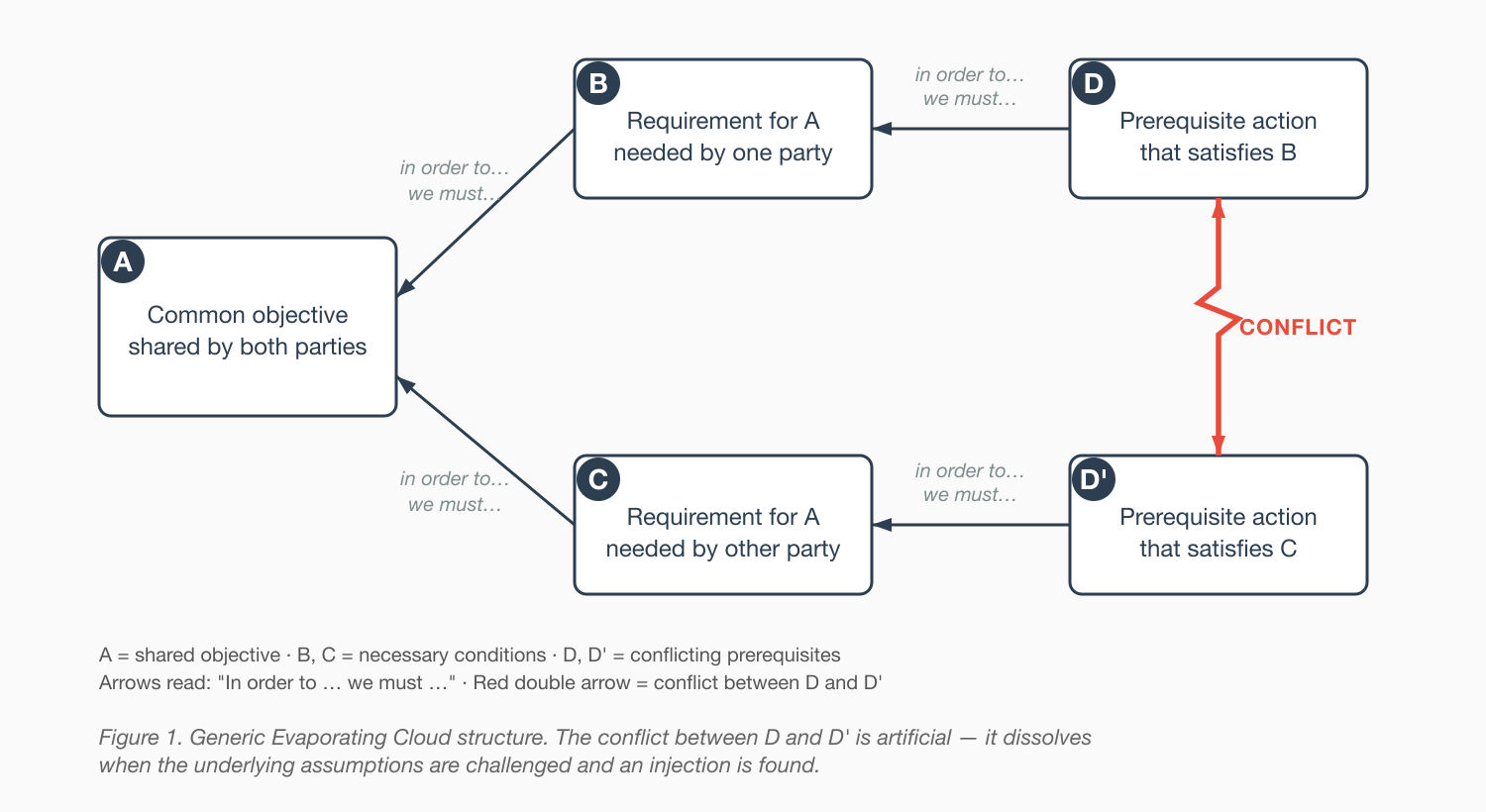
Figure 1. Generic Evaporating Cloud structure. The conflict between D and D’ is artificial — it dissolves when the underlying assumptions are challenged and an injection is found.
Each arrow represents a necessity claim. Read from right to left: “In order to achieve A, we must have B, because [assumption].” The assumptions on each arrow are the hidden drivers of the conflict. Challenging any one of them can dissolve the conflict. The goal of the Evaporating Cloud is to find an injection — a new action or insight that invalidates at least one assumption, allowing both B and C to be satisfied without requiring the incompatible actions D and D’.
Worked Example: Batch Size from “The Goal”
Goldratt’s classic example from The Goal illustrates the method clearly:
- A: Keep the business running profitably
- B: Maintain production efficiency
- C: Maintain customer responsiveness
- D: Produce in large batches (efficient for machine utilization)
- D’: Produce in small batches (responsive to customer demand)
The conflict between D and D’ appears real. Large batches waste inventory and delay delivery; small batches waste setup time and reduce throughput. The assumption on the D arrow is: “large batches are needed for machine efficiency because setup time is long and costly.” The assumption on the D’ arrow is: “small batches are needed for responsiveness because customers cannot wait.”
The injection is SMED (Single-Minute Exchange of Die), a technique for reducing setup time. When setup time drops from hours to minutes, large batches are no longer needed for efficiency. The conflict evaporates. Both B and C can be satisfied simultaneously. Neither production efficiency nor customer responsiveness is sacrificed.
This is not a compromise. A compromise would be: “produce in medium batches.” The Evaporating Cloud produces something better: a solution that satisfies both needs fully, by attacking the assumption that created the apparent conflict.
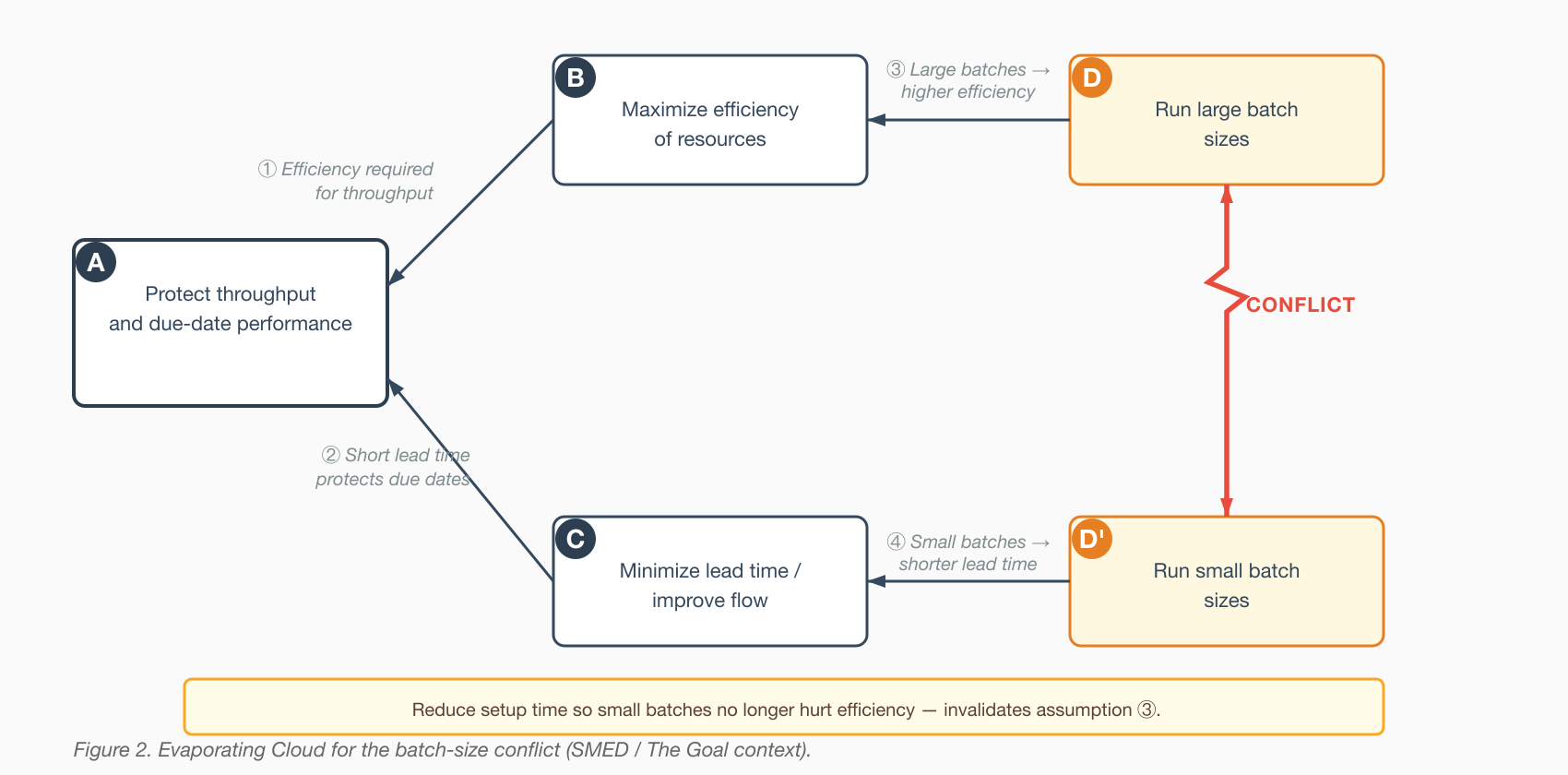
Figure 2. Evaporating Cloud for the batch-size conflict (SMED context).
Worked Example: CBA Break-Relief Conflict
Returning to the hospital example:
- A: Deliver safe, compliant healthcare sustainably
- B: Nurses receive lawful meal and rest breaks
- C: Patient care remains continuous and safe
- D: Schedule dedicated break relief (a third nurse who covers breaks)
- D’: Maintain continuous staffing (no gaps in nurse coverage)
The assumptions on each arrow:
- D to B: “Break relief requires a dedicated third nurse who sits idle otherwise.”
- D’ to C: “Patient care truly cannot be interrupted for thirty minutes in any circumstance.”
Injections:
- Staggered relief pools that serve multiple units, eliminating idle time.
- Acuity-based scheduling that defines handoff windows where safe, rather than treating all units as equally interruptible.
- Redefining “continuous care” to include structured, brief handoffs during break periods, validated by clinical outcomes data.
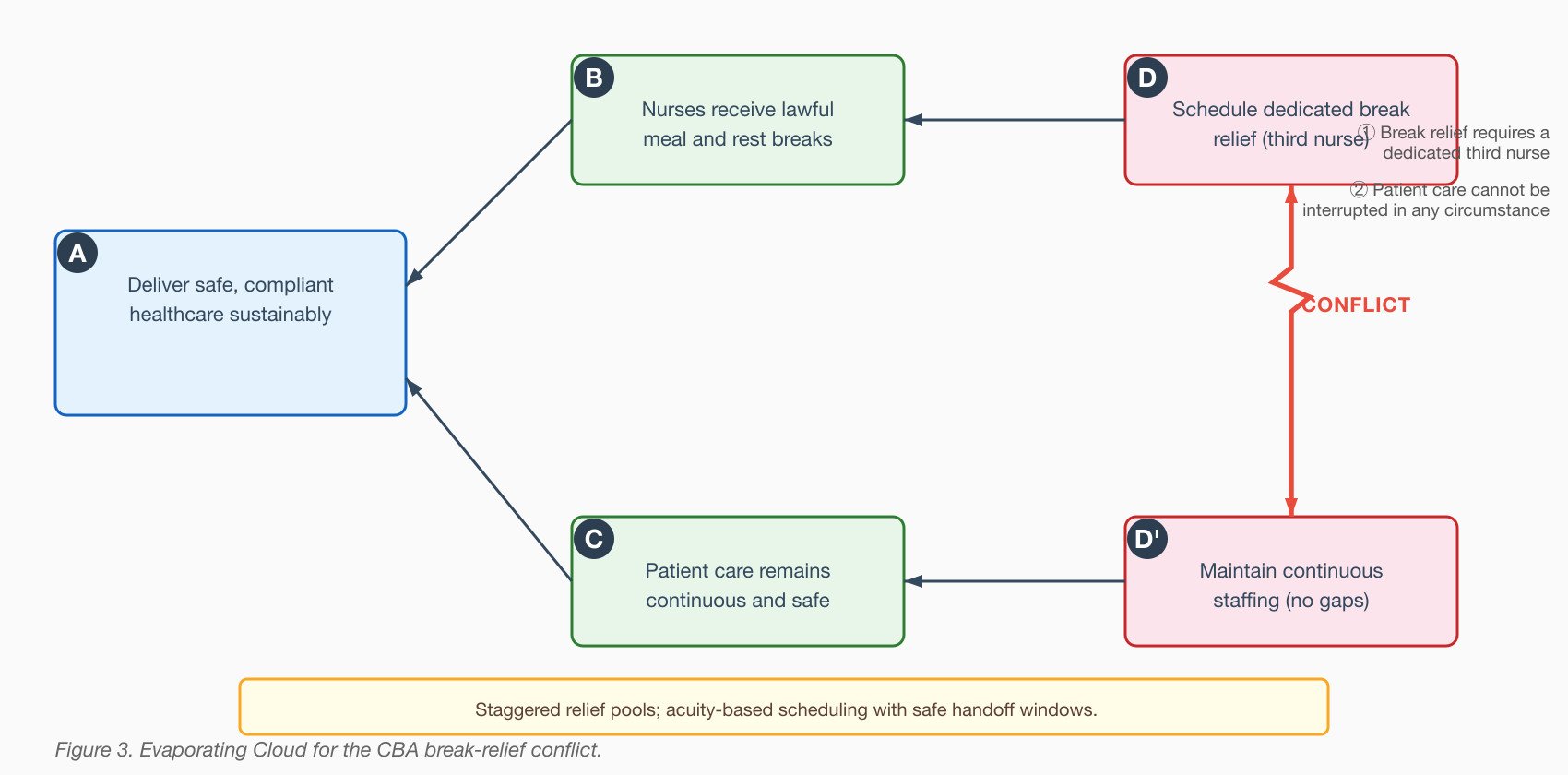
Figure 3. Evaporating Cloud for the CBA break-relief conflict.
The conflict evaporates when the assumptions are challenged. Neither lawful breaks nor continuous care is sacrificed. The injection satisfies both needs by attacking the belief that created the apparent incompatibility.
The Evidence: Structural Conflicts in the Real World
Structural conflict is not a theoretical abstraction. It is an observable, countable feature of the documents that govern real workplaces. When the clauses of a collective bargaining agreement are examined not as isolated promises but as an interacting system, contradictions appear with regularity. They are not drafting errors in the ordinary sense. They are the predictable residue of separate negotiations, each conducted in good faith, each aimed at a legitimate interest, and each producing language that collides with language produced elsewhere in the same instrument.
The result is a contract that cannot be fully performed as written. Someone must lose, or someone must improvise around the text. Either outcome erodes trust.
Failure Modes: When the Cloud Does Not Evaporate
The Evaporating Cloud is powerful, but it is not magic. There are conditions under which it works well and conditions under which it struggles. Understanding these failure modes is essential to using the method effectively.
Failure Mode 1: The Conflict Is Genuine
Sometimes D and D’ truly are incompatible. The assumptions connecting them to B and C are solid, and no injection can invalidate them without changing the fundamental nature of the problem. In these cases, the cloud still provides value: it forces the parties to verify that the conflict is genuine before they begin fighting. Many conflicts that appear genuine turn out to be artifacts of unexamined assumptions. The ones that survive the test are the ones worth fighting about.
Failure Mode 2: A Is Not Shared
If the two parties do not genuinely share objective A, the cloud is built on sand. This is more common than it seems. Parties often agree to a stated objective (e.g., “improve patient outcomes”) while privately pursuing different interpretations of what that objective means. The cloud will still produce a diagram, but the diagram will not resolve the underlying disagreement.
Failure Mode 3: Assumptions Are Too Coarse
If the assumptions on the arrows are stated too broadly, they become difficult to challenge. “We need large batches because efficiency matters” is too vague to test. “We need large batches because our setup time is forty-five minutes and our daily demand is two hundred units” is testable. The granularity of the assumptions determines the granularity of the resolution.
Failure Mode 4: Political Resistance
Even when a cloud correctly identifies an injectable assumption, the people who hold that assumption may resist having it challenged. This is not a failure of the method; it is a feature of human psychology. The assumptions that lock a conflict in place are often tied to identity, status, or professional pride. Challenging them feels like a personal attack.
This is precisely where AI assistance changes the dynamics. An AI system can surface and challenge assumptions without triggering the defensive reactions that human-to-human challenge produces. The assumptions are examined on their merits, not as reflections on the people who hold them.
Why AI Changes Everything
The Evaporating Cloud method has been available since the mid-1990s. It is taught in TOC training programs, written about in management literature, and used by consultants who specialize in organizational conflict. Yet it has never become mainstream. The reasons are the same ones that kept principled negotiation artisanal: cognitive load, training requirements, facilitation cost, and the scarcity of skilled practitioners.
AI systems remove all four barriers simultaneously.
An AI system can construct a cloud from natural-language descriptions of a conflict in minutes. It can enumerate assumptions, test them against evidence, and propose injections without fatigue or bias. It can maintain consistency across hundreds of clouds, surfacing patterns that a human facilitator would miss. It can do this at marginal cost, overnight, and present the results in a form that human decision-makers can interrogate, amend, or reject.
The bottleneck moves from analysis to action. The question is no longer “Can we afford to analyze this conflict properly?” but “Which of the surfaced resolutions do we choose to act on?”
What We Are Building
At Common Sense, we are building tools that apply the Evaporating Cloud method at organizational scale. Our approach combines the rigor of Goldratt’s Thinking Processes with the reach and consistency of modern AI systems. The result is a conflict-resolution infrastructure that can continuously monitor, analyze, and propose resolutions for the friction points that slow every organization down.
If you are interested in learning more, or in exploring how this approach might apply to your organization, we would welcome the conversation.
This article is based on a 24-page research paper available from Common Sense Systems, Inc. The paper includes additional worked examples, a deeper treatment of failure modes, and a bibliography of the underlying research.