The One Thing Slowing Down Your Business (And How to Find It)
Every business has one thing that limits how much it can get done. Find that one thing, fix it, and everything improves. Fix anything else, and nothing changes. A practical guide for small business owners.
TL;DR
Every business has one thing that limits how much it can get done. Improving that one thing improves everything. Improving anything else changes nothing. Most small business owners spend their time and money improving the wrong things. Here is how to find the right one.
Mike runs a residential remodeling company. Three crews. Good reputation. Steady referrals. He should be doing well, and in some ways he is. But he is working sixty-hour weeks, jobs routinely run two to three weeks late, and his margins are thinner than they should be for the volume he is doing.
He has tried the obvious fixes. He hired a project coordinator. He bought scheduling software. He started holding Monday morning meetings. Each one helped a little, for a while. None of them solved the underlying problem. Mike cannot quite name the problem, but he feels it every day: the business is busy, but it is not really moving forward.
Mike has never heard of Lean manufacturing or the Theory of Constraints. He does not need to. What he needs is one idea, and it is this:
In every business, there is one thing that limits how much you can get done. If you improve that one thing, everything gets better. If you improve anything else, nothing much changes.
That is the whole insight. The rest of this article is about how to use it.
Finding Your One Thing
The natural instinct is to improve whatever is most visibly broken. The crew that is always behind. The supplier who is always late. The paperwork that piles up. But visible problems are not always the ones that matter most.
Here is a better way to think about it. Imagine your business as a chain. Orders come in on one end. Finished work and paid invoices come out the other. Every link in the chain is a step: selling the job, getting permits, ordering materials, scheduling crews, doing the work, handling inspections, closing out the project, collecting payment.
The chain is only as strong as its weakest link. More precisely, the chain can only move as fast as its slowest link. That slowest link is the constraint. Everything upstream of it piles up. Everything downstream of it waits.
For Mike, the constraint turned out to be himself. Every change order, every material substitution, every customer question about scope had to go through him personally. His crews could only move as fast as he could answer questions, approve changes, and make decisions. He was the bottleneck in his own business, and no amount of scheduling software or Monday meetings was going to change that. Those improvements were on the wrong link of the chain.
The Five Steps
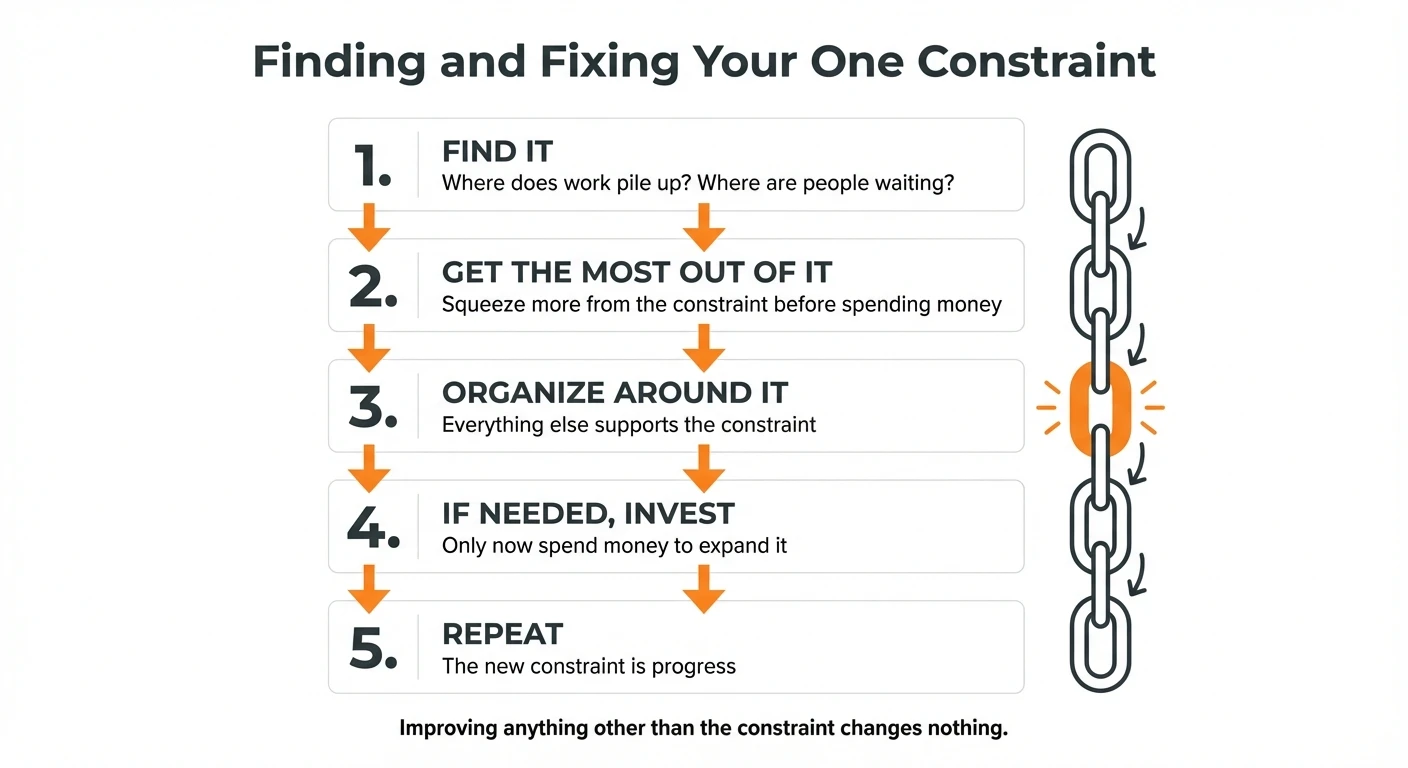
Once you know what to look for, the process is simple. It was developed by a physicist named Eli Goldratt, who spent his career helping businesses find and fix their constraints. He laid it out in five steps.
Step 1: Find the constraint. What is the one thing that limits how much your business can produce? Look for the place where work piles up, where people are always waiting, or where you are personally the bottleneck. In a remodeling business, common constraints include the owner’s decision-making capacity, permit turnaround times, a specific subcontractor who is always behind, or the availability of a specialized crew (tile, electrical, plumbing).
Step 2: Get the most out of it. Before you spend any money, squeeze everything you can out of the constraint. If the constraint is you, that means delegating decisions that do not actually require your judgment. If the constraint is a subcontractor, it means making sure they are never waiting on you for information, materials, or access. If the constraint is permit processing, it means submitting applications the day the contract is signed instead of waiting until plans are finalized.
This step alone often produces surprising results. Most constraints are operating well below their potential because the rest of the business is not organized to support them.
Step 3: Organize everything else around it. This is the step people skip. Once you know what the constraint is, everything else in the business should be arranged to keep it running at full capacity. That might mean your sales process paces new work to what the constraint can handle rather than booking everything that comes in. It might mean your material ordering is timed to the constraint’s schedule, not to a generic calendar.
For Mike, this meant giving his lead carpenters authority to approve change orders under a certain dollar amount without calling him. It meant pre-building a decision guide for common material substitutions. It meant his project coordinator’s primary job was not tracking schedules but keeping decisions flowing to the right people before they became bottlenecks.
Step 4: If needed, invest. Only after Steps 2 and 3 have been fully applied should you spend money to expand the constraint. Maybe that means hiring a second lead who can handle the jobs you used to run personally. Maybe it means switching to a faster subcontractor. Maybe it means paying expedite fees on permits for jobs above a certain size.
The reason this step comes last: if you invest before you have gotten the most out of what you have, you will spend money solving a problem that better organization could have solved for free. Most small businesses jump straight to this step, which is why they are always investing but never quite getting ahead.
Step 5: Do it again. When you fix one constraint, another one becomes the new limit. That is not a problem. It is progress. The business that was stuck at $1.2 million in annual revenue because the owner was the bottleneck might get to $1.8 million once that constraint is broken. Now maybe the new constraint is crew capacity, or estimating bandwidth, or cash flow. Find it, work through the steps again.
What This Looks Like in Practice
Here is what changed for Mike (and what typically changes for businesses like his).
Before: Mike was on the phone constantly, answering questions from three crews, approving every decision, personally visiting every job site at least once a day. His crews would wait an hour or two for answers. Jobs ran late. Customers got frustrated. Mike worked sixty-hour weeks and felt like he was falling behind anyway.
After: Mike identified himself as the constraint. He built a simple decision guide for his lead carpenters covering the twenty most common on-site decisions (material substitutions, minor scope changes, scheduling adjustments). He set a dollar threshold: anything under $500, the lead decides. He moved his project coordinator’s focus from schedule tracking to decision support, making sure leads had the information they needed before they needed it.
Within a month, his crews were waiting less. Jobs started finishing closer to schedule. Mike’s phone rang less. He got back roughly ten hours a week, which he used to estimate new work, something he had been too busy to do consistently. Revenue went up not because he worked harder, but because the constraint was no longer choking the system.
He did not need to learn management theory. He needed to find the one thing that was slowing everything down and fix it.
Common Constraints in Small Businesses
Different businesses have different constraints. Here are patterns I see frequently.
The owner is the bottleneck. This is the most common constraint in businesses under $5 million in revenue. Every decision, every approval, every customer conversation goes through one person. The business can only grow as fast as that person can process information and make choices. The fix is almost always some combination of delegation, decision guides, and clear authority boundaries.
A key employee or subcontractor. If one person or team has a specialized skill that no one else can do, they become the constraint. The fix is either cross-training (so the skill is not concentrated in one place), or organizing the entire workflow to ensure that person is never waiting on anything.
Cash flow. You have the work, the people, and the capacity, but you cannot start the next job until the last one pays. The constraint is in the financial process, not the operational one. The fix is usually in billing frequency (progress billing rather than completion billing) or payment terms with suppliers.
Estimating and sales. You have the capacity to do more work, but you cannot generate enough bids or close enough deals to fill the pipeline. The constraint is at the front end. Adding more crews or buying more equipment will not help.
External processes. Permits, inspections, supplier lead times. These are constraints you do not control directly, but you can organize your business to minimize their impact. Submit earlier. Build buffer time into schedules for the steps you know are unpredictable. Do not let an external constraint sit idle because you were not ready on your end.
Why “Improve Everything” Does Not Work
The temptation is always to improve everything at once. Better scheduling. Better communication. Better tools. Better trucks. The problem with improving everything is that only one improvement actually matters at any given time, and the rest are wasted effort.
If your constraint is the owner approving every decision, then better scheduling software does not help. If your constraint is cash flow, then a new truck does not help. If your constraint is a slow subcontractor, then Monday morning meetings do not help.
This is not intuition for most people. It feels productive to improve things. But improving a non-constraint is like widening a four-lane highway when the bottleneck is a two-lane bridge five miles downstream. More lanes, same traffic jam.
The discipline is to find the constraint first, then improve only at the constraint, then make sure everything else supports it. That sequence, applied consistently, produces compounding results over time. Not because you are working harder, but because every improvement effort is aimed at the thing that actually matters.
Going Deeper
The idea behind this article comes from the Theory of Constraints, developed by Eli Goldratt. His book The Goal tells the story through a manufacturing plant, but the thinking applies to any business. It is a novel, not a textbook, and it is a fast read.
For a more detailed look at how this thinking integrates with other improvement methods (including Lean, which you may have encountered in a different context), see our reference page on TOC and Lean integration.
If you are running a small business and something about this resonates, I am happy to think through your specific situation. Sometimes a thirty-minute conversation is enough to identify the constraint. Reach me at john@common-sense.com.
Sources
- [en.wikipedia.org/wiki/The_Goal_(novel](https://en.wikipedia.org/wiki/The_Goal_(novel)
- Theory of Constraints (Wikipedia)
- TOCICO
- NIST AI Risk Management Framework
- AHRQ patient safety culture resources