Tesla After Q2 2026: What I Would Recommend
A review of Tesla's Q2 2026 shareholder update and 10-Q, what the filings say limits the business today, and a plan for the next two quarters built on finding and managing that limit.
TL;DR
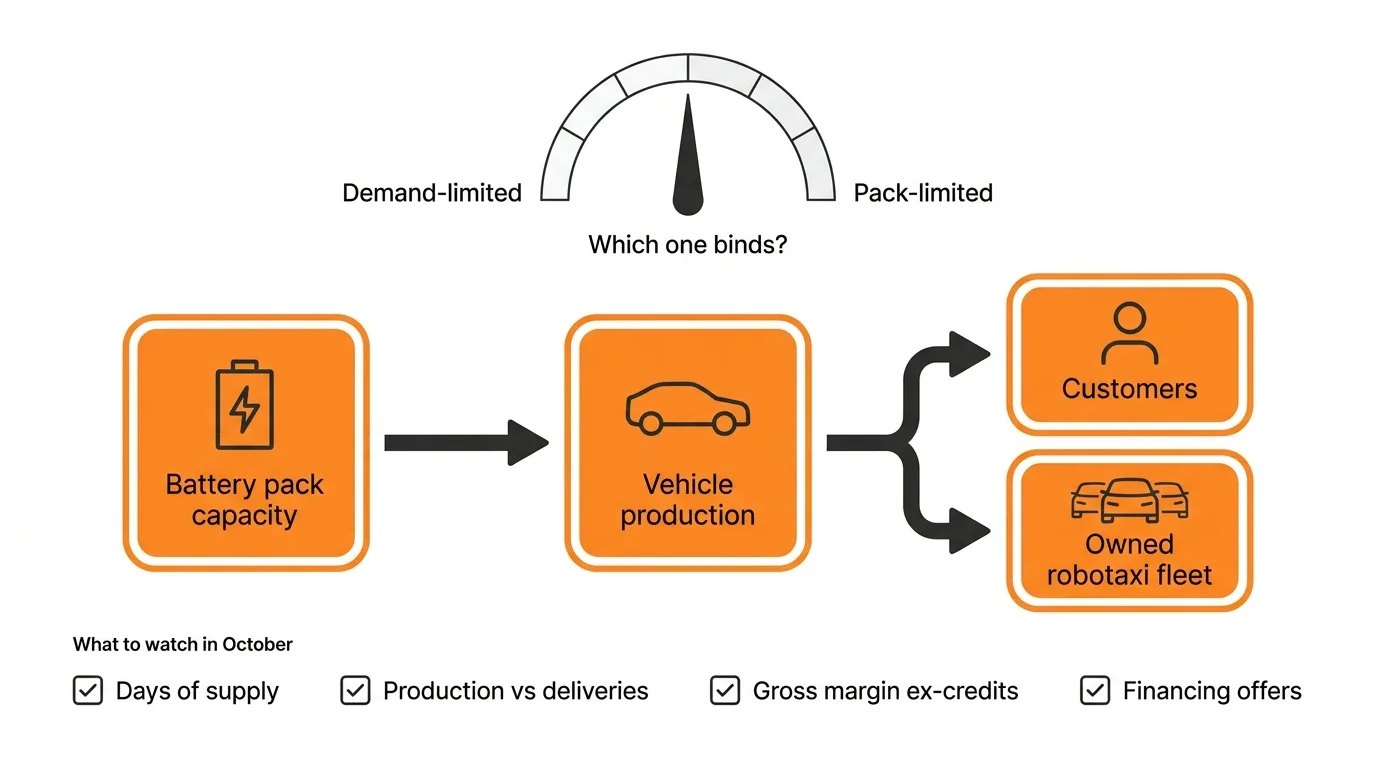
Tesla’s Q2 2026 filings name battery pack capacity as what limits raising vehicle production, and name aggregate demand among what limits deliveries. The filings cannot say which binds. The plan below starts by finding out, then manages the vehicle business around the answer and keeps the rest of the company clear of it.
The facts from the filings
This review uses two documents: the Q2 2026 Update and the Form 10-Q for the quarter ended June 30, 2026. The earnings call is used in two places and is marked where it is.
Volume. Deliveries were 480,126, a second-quarter record. Production was 451,758. Deliveries exceeded production by about 28,000 vehicles. New-vehicle inventory fell to 15 days of supply from 27 at the end of Q1. The last five quarters run 24, 10, 15, 27, 15. Days of supply is defined in the deck as new-vehicle ending inventory divided by the quarter’s deliveries, on 75 trading days.
Revenue and margin. Total revenue was $28.2B. Automotive sales revenue was $20.0B at a 15.7% gross margin, excluding regulatory credits and leasing. Regulatory credit revenue was $146M, down from $439M a year earlier. Energy generation and storage revenue was $3.14B at a 20.4% gross margin, down from 30.3%, with a lower average selling price per Megapack and a warranty charge for a vendor cell issue. Of the energy revenue, $318M was from SpaceX, reported in the 10-Q as a related-party transaction.
Cash. Operating cash flow was $4.7B. Capital expenditures rose $3.3B from the prior quarter. Free cash flow was negative $1.1B. Cash and investments ended at $43.5B. On the call, the CFO guided full-year capex above $25B.
Inventory. Finished goods rose to $5.93B from $4.85B at year end. Raw materials were $4.70B, from $4.52B. Finished goods includes vehicles in transit, used vehicles, and energy products not yet deployed.
What Tesla says limits it. The deck states it twice. “Progress also continued on battery pack capacity expansion – the main limiting factor to near-term vehicle production volume increase.” And: “We continue to work on initiatives to increase battery pack capacity as it remains the limiting factor on ramping our vehicle production globally.” The additions listed are vehicle pack capacity in Berlin, cathode material and lithium refining in Texas, LFP cells in Nevada for storage, and more 4680 cells for Cybercab, Semi, and Model Y.
What Tesla says limits deliveries. The outlook reads: “Deliveries and deployments will be impacted by aggregate demand for our products, supply chain readiness and allocation decisions between sale to customers or use for our owned and operated fleet.” Three items, unranked.
What the filings do not contain. No order backlog figure. The CFO said on the call that Tesla exited Q2 with its largest order backlog since 2023; no number accompanies it in either document. No Optimus unit count. No Cybercab production rate. No Robotaxi fleet size, paid miles, or revenue. No pack-line utilization.
Incentives. During Q2 Tesla sold a Model Y Standard trim priced below the Premium trims and offered 0% financing for 72 months in North America. This is from market coverage, not the filings. The deck’s margin bridge lists lower average selling price, inclusive of mix, as a negative for the quarter.
The analysis
A business is limited at any moment by one thing. Everything else has spare capacity relative to it. Improving anything other than that one thing does not raise the output of the whole. The first job is to find it. The second is to get the most out of it before spending to add more.
For the vehicle business, the filings leave two leading candidates. Others are possible, including logistics, electronic components, and regional mix, and the filings do not rule them out.
The first is battery pack capacity. Tesla names it as what limits production. If customers are waiting on cars at current prices, this is the constraint, and the work to do is to get every available hour from the pack lines, feed them without interruption, and add pack capacity where it is cheapest and fastest.
The second is demand for the current vehicle lineup. Tesla names it in the outlook. Revenue fell in 2025, the first annual decline. Inventory reached 27 days in Q1. Q2 volume came with a cheaper trim and subsidized financing. If the orders do not hold when those come off, pack capacity is not the constraint. The market is. Additional packs become inventory. The work to do is different: change the offer until buyers queue at a price that leaves a margin, and stop adding production capacity until they do.
The filings cannot distinguish these cases. A production limiter and a throughput limiter are different things. A plant can be unable to build faster and still build more than it can sell. The 15 days of supply is consistent with either reading. It is where Tesla sat at the end of 2025, before the Q1 build-up, and it was reached by delivering 28,000 more cars than were built in a quarter with unusual incentives.
Two further points from the filings bear on any plan.
Energy is a second business with its own limit. The deck reports 13.5 GWh deployed in Q2, and lists installed Megapack capacity of 40 GWh in California and 20 GWh in Shanghai, with Texas commissioning. The 10-Q says Tesla “will have to maintain adequate battery cell supply for our energy storage products,” and that deployments “can vary meaningfully quarter to quarter depending on the timing of specific project milestones.” Margin fell 10 points year over year. The selling price per Megapack fell. A tenth of the revenue came from a related company. Energy is growing. Whether it is limited by supply, by project timing, or by price cannot be read from the filings, and this plan does not assume an answer.
Physical AI does not yet touch the constraint. Cybercab production has begun. Engineering test drives on public roads and employee rides at Gigafactory Texas started in the quarter. On the call, Musk said Tesla needs to accumulate driving data specific to the Cybercab before putting many on the road. Optimus lines are being installed, with initial builds going to an internal training program. Neither product generates revenue at the margin today. They are investments in a future offer. The one point of contact with today’s constraint is the outlook’s phrase about allocation “between sale to customers or use for our owned and operated fleet.” If packs bind, each vehicle kept for the fleet is a vehicle not sold to a customer. At the current fleet size this is immaterial. The rule for deciding it should exist before it is material.
The recommendation
The plan has four parts. The first is to find out, in one quarter, which of the two candidates binds. The second is to get the most from whichever it is. The third is a set of actions that are right in either case. The fourth is to set up physical AI so that it can be managed the same way when its time comes.
1. Find out which candidate binds
Tesla knows the answer from internal order, cancellation, and line data. Outsiders will read it from the October filings, on the definitions already in the deck. Four fields carry most of the information:
- New-vehicle days of supply. Mid-teens or lower without incentives means demand holds and pack capacity binds. A drift back toward 20 to 27 means Q2 was pulled forward and the market binds.
- Production versus deliveries. Deliveries above production again, without incentives, means cars are wanted faster than they are built. Production above deliveries means the reverse.
- Automotive sales gross margin, excluding credits. Holding or rising as incentives come off means the demand is contribution-positive. Falling means volume is still being bought.
- The incentive status. Whether the promotional financing of Q2 and Q3 is still in place, and what it costs. If it is, a lean inventory number is not a demand number.
One quarter of these fields will not settle every case. Logistics timing, regional mix, and a product launch can each move them. Read together, and with the direction from Q2, they narrow it considerably.
The question does not have to wait for the filing. Tesla’s own website reports two of the relevant facts every day: the delivery estimate on a custom order at list price, and the new-vehicle inventory available within a given distance. A queue that exists shows up as a wait. A lot full of unsold cars shows up as inventory and discounts. Sampling both across several regions for two weeks, with the financing offer logged each time, gives an early read on the same question the filing will answer.
A first sample, taken August 22 from a Seattle-area delivery location with the cash price selected: a Model 3 Standard at $36,990 showed an estimated delivery of January to March 2027. A Model Y Standard at $39,990 showed October to November 2026. The Premium and Performance trims of both models showed three to four weeks. New inventory within 200 miles of five large metros held no Standard-trim vehicles at all; what was in stock was Premium and Performance, at list, with discounts confined to demonstration units. The 0% financing offer from Q2 had ended. A 0.99% rate for 72 months remained on Model Y.
One day in one country is not a finding. The cheapest trims carry the longest waits, the dearest the shortest, and there is no discounted inventory. That is consistent with supply-limited output allocated toward the trims that earn most. It is equally consistent with a Standard trim built in small volume by design, and the two cannot be told apart from a configurator. The subsidized rate is still on, so the waits are not at list terms. The reading is undetermined. What the sample rules out is the simplest demand story: cars available now, discounted, in every region. The same sample repeated through early September, with the financing offer logged each time, will show a direction or not.
If Tesla chose to publish a single additional number, it should be order backlog in units at list price, excluding orders placed under promotional financing. That one disclosure would settle the question for outsiders and would discipline the internal conversation as well.
2a. If pack capacity binds
Treat the pack lines as the step that sets the pace of the vehicle business.
- Protect their hours. Pack-line hours lost to changeovers, unplanned stops, and upstream starvation are lost sales. Plan maintenance to maximize the lines’ availability, and schedule the rest of the plant around them rather than the reverse. Hold a stock of cells and modules in front of them so that a late supplier does not stop them.
- Measure them in margin, not units. Report pack-line utilization and the margin earned per pack-line hour, by plant, weekly. A pack that goes into an unsold car is not output.
- Allocate pack capacity by margin. When packs are short, they go first to the vehicle and trim that earns the most per pack-hour. The allocation rule should be written, and a vehicle kept for the owned fleet should be charged the retail margin it displaces, net of what the fleet vehicle is expected to earn, so that the cost of keeping a car is visible.
- Add pack capacity where it is fastest. Berlin pack capacity is already in the plan. If the limit is in pack assembly rather than cells, more cells do not relieve it. The filings do not say which. Tesla knows, and should say, because it determines whether the $25B capex is pointed at the constraint or past it.
- Do not add vehicle assembly capacity for its own sake. Q2 production ran well below the installed capacity listed in the deck. A new assembly line adds nothing while packs bind; capacity for a new product is a separate decision.
2b. If demand binds
Treat the market for the current lineup as the constraint. The work is on the offer, not the factory.
- Price the financing subsidy as what it is. A below-market loan for 72 months is a price cut spread over six years. It fills the quarter. It is worth continuing only while the margin on the added sales, after the subsidy, is positive. If it is not, the answer is a better offer, not a cheaper one.
- Change the offer. The Model Y Standard trim is one version of this. Others exist: FSD subscriptions bundled at the point of sale, which the CFO said on the call reached about 55% of North American deliveries in Q2; a service and charging package priced into the car; trade-in and residual guarantees that reduce the buyer’s risk rather than the price. Each of these raises what the buyer gets at a given price instead of lowering the price.
- Hold production to demand. Build to orders, not to capacity. Rising inventory at list price is the signal to slow, not to discount.
- Slow expansion that is not tied to a committed ramp. Capacity added in front of a market constraint becomes inventory. Pack work for new products has long lead times and should continue; pack capacity for volume that is not selling can wait.
3. In either case
- Report throughput, not deliveries. Deliveries are a unit count. What matters is sales minus the cost that varies with each unit sold. A quarter that sets a delivery record on a falling margin may have produced less of this than the quarter before. One line in the deck, by segment, would make the trend visible.
- Manage the energy business to its own limit. Whatever it is, it is not the vehicle pack lines. The 10-Q already discloses the related-party revenue; adding the related-party share of deployments would let demand be read clean.
- Keep capital where it is. Free cash flow was negative $1.1B on $5.8B of capex. With $43.5B on hand this is a choice, not a problem. But capex pointed at a non-constraint is capital spent for no increase in output. Every large project should be able to state which limit it relieves.
- Write the allocation rule now. Customers versus owned fleet. The rule should say what price a fleet vehicle is charged against, and who decides when the fleet’s claim on production exceeds a stated share. Writing it while the number is small is cheap. Writing it when the number is large is a fight.
4. Prepare physical AI to be managed the same way
Cybercab and Optimus will have constraints of their own once they have customers. Today neither has a queue. The preparation is to define, in advance, the measures that will show one forming.
For Robotaxi: ride requests not served for lack of a vehicle; vehicles idle waiting for charging, cleaning, inspection, or a remote-assistance operator; paid hours per vehicle per day. Depot, charging, and support capacity should be built ahead of the fleet, not behind it, so that the first limit the service meets is demand rather than its own turnaround.
For Optimus: tasks completed without human intervention, per unit per shift; the rate at which units move from the training program to productive work. Until an external customer exists at a stated price, Optimus is investment. It should be reported as such.
For both: the date of first external revenue, and the number of customers waiting on that date. When that number is larger than Tesla can serve, physical AI has a constraint and the plan above applies to it.
Why this plan
It spends nothing on finding the constraint. The four fields are already reported or nearly so.
It sequences the work. Getting more from the constraint comes before adding to it. Adding to the wrong one is the most expensive mistake available, and at $25B of annual capex it is not a small one.
It separates the businesses. Vehicles, energy, and physical AI each have their own limit and their own measures. Treating them as one system hides which one is moving.
It keeps the two businesses separate in the reporting. Physical AI is the future of the company by Tesla’s own account. The plan does not argue with that. It asks that the investment be reported as investment until it has customers, and that the limit on the current business be named and managed in the meantime, because the current business is paying for the future one.
The October filings may show whether the near-term limit is packs or buyers, and the website will show a direction sooner. Either answer is workable. The plan for each is above.
Notes
The method here is the Theory of Constraints, developed by Eliyahu Goldratt. The sequence of identify, get the most from, subordinate to, add to, and repeat is his Five Focusing Steps. TOCICO maintains the body of knowledge. A short introduction is on Grokipedia.
Sources
- Tesla, Q2 2026 Update, July 22, 2026: limiting-factor statements; outlook; days-of-supply definition and series; deliveries and production; margin bridge; cash and capex; installed capacity tables
- Tesla, Form 10-Q for the quarter ended June 30, 2026: segment revenue and cost of revenue; inventory by class (Note 4); regulatory credits; SpaceX related-party Megapack revenue; energy average selling price and warranty commentary; cell-supply statement for energy storage
- Tesla Q2 2026 earnings call transcript, July 22, 2026: order backlog statement (CFO); Cybercab driving-data statement (Musk)
- Teslarati, July 2026: Q2 trim pricing and financing offers (secondary)