The Business That Is Too Painful to Scale, but Too Good to Quit
A plumbing contractor called me out of the blue, stuck between not being able to hire and not being able to run the business he has. The constraint was not labor. It was the machine that was never built.
TL;DR
A plumbing contractor called me out of the blue. Someone he knew had given him my name, and a few weeks later I got a call from a man who was, in his own words, stuck. He had real demand, a couple of big signed jobs, and enormous hours. He also had idle time, at the same time as the overload. He could not see how to hire his way out, because the business only ran through him.
The constraint in his business was not labor. It was the operating system: no written scope or pricing, no paperwork before work started, no way to screen a customer, no way to say no. The paid lead marketplace he was unhappy with was not the villain. It was a mirror, showing him in dollar terms exactly where the business was thin.
The way out is not more leads. It is the machine: standard scope and pricing, a contract before the truck leaves, a scope-change policy, a front door, and a commitment to the channel where the good customers come from. Build that first, and the conflict dissolves.
He called on a Sunday. I could tell he had other things going on, business-related, on that Sunday. Twenty-five minutes on the phone, and he told me the whole story.
It is a story I think a lot of skilled operators know from the inside, so I am telling it here with his permission, anonymized, and with one change: I have shifted the details just enough that he cannot be picked out. The substance is his, and the reading of it is mine.
A success story that feels like a trap
On paper, his business is a success. Customers want to work with him. He has signed up for a couple of big jobs. Demand is not the problem.
In practice, it is a Sunday-morning scramble. He is working enormous hours. The big jobs will not start, or will not progress the way he needs them to. And here is the part that confused him most: he has idle time, at the same time as he is overloaded. He wants to hire people to grow the business, but he cannot see how that helps when he cannot even take care of the business he has got.
His own words captured the conflict exactly:
“I can’t hire more people, and I can’t take care of the business I’ve got.”
That sentence is the whole story. In Theory of Constraints terms, it is a structural conflict: two legitimate needs in direct opposition, and a person caught in the middle. He is not being irrational. The structure is putting him there.
The mirror with a price tag
Part of his frustration was about a lead marketplace, the kind of site where homeowners post a job and service professionals pay to get the lead. He was paying substantial fees, and he was unhappy about it.
So I went and checked how the model actually works, because it is worth understanding. What I found:
- It is pay-per-lead, with no subscription. You pay when a customer connects with you, a message, a call, a booking. Prices are dynamic and auction-like, and contractors commonly report paying somewhere in the $35 to $60 range, with leads going as high as $100 to $200 in competitive categories.
- The same lead is sold to multiple professionals at once. A homeowner posts a request and can contact as many pros as they like, and the homeowner pays nothing. Contractors on the platform’s own community forums document leads where the customer contacted five pros, and in competitive categories five to fifteen pros can be fighting over the same request.
- You are charged at the point of connection, even if you lose the job. One contractor documented being charged for a lead where the customer hired another pro before he could even make contact.
- It is a race to respond first. Whoever reaches the customer fastest, with the clearest scope and the strongest close, wins.
Read that list again. The model structurally rewards four things: fast response capability, high conversion with clear scope and pricing, airtight paperwork, and demand that actually exceeds capacity.
Now look at the contractor in this story. He is overloaded, so he cannot respond fast. He has no written scope or pricing policy, so jobs inflate on-site while the price does not. He has no paperwork before work starts. And his demand problem is not a lack of leads; it is a lack of a machine to process them.
He was paying a premium for a race he was set up to lose.
Here is the no-losers reading of that. The marketplace was not the villain. It was a mirror. It showed him, in dollar terms, exactly where the business was thin. A business with the operating system in place would have found the same leads cheap. The lead price was the visible symptom. The missing conversion capability was the actual cost driver.
The customers who play games
Two of his recent customers had ended up at a court date. When I asked about it, the pattern was clear, and it was not that he was unlucky.
The small job inflates once he is on-site, but the price does not. Customers haggle once the work is underway. And he was taking on work from people he could tell, a priori, were likely to play these games, because he could not bring himself to turn down work.
None of that is a character problem. It is a configuration problem. A business without a front door lets in anyone:
- No screening, no way to qualify a customer before committing.
- No paperwork, no written estimate or signed agreement before the truck leaves the driveway, so scope and price are verbal and renegotiable on-site.
- No scope-change policy, so if the job inflates on-site, nothing says the price inflates with it, in writing, on the spot.
- No “no” policy, so work is accepted from anyone, including the customers most likely to become disputes.
The customers you want are the ones who do the work, pay, and say “see you later.” Not the ones who say “now it is time to haggle over price.” The difference between those two customers is almost never the customer. It is whether the business has a front door.
And notice the loop this creates. Every dispute consumes the very hours he needs to build the system that would prevent the next one. The business runs too poorly to scale, but well enough that he does not want to quit it. That is the trap, and it is a trap only skilled people fall into, because only skilled people get enough demand to be stuck in it.
The referral channel that was not working
He was also getting fewer referrals than he expected from his business networking group. His first instinct was to wonder why the group had not been working for him, and that is a fair question. But the answer was not the group.
Referrals in a group like that follow three things:
- Consistent presence. Irregular attendance makes a member forgettable and unreferable.
- Demonstrated readiness. Members refer people they trust. If a one-on-one partner senses the business is not ready to receive a referral smoothly, if the business is a scramble, the referral does not happen. It is not cynicism. It is protection. Nobody wants to hand a friend a bad experience.
- Reciprocity. Referrals flow to people who make referrals.
So the low referral volume was not the group failing him. It was the same missing machine, showing up in a different channel. The fix is two-part: commit to showing up consistently, and fix the business so that when a warm referral does arrive, it lands smoothly, screened, papered, priced, delivered.
The way out
The constraint in this story is not labor. It is the operating system.
Hire people without a system and you multiply the chaos: more people, more verbal agreements, more on-site ambiguity, more disputes. Do not hire, and the owner stays the single bottleneck: his hours cap the business, and the big jobs stall because only he can run them. Idle time and overload coexist because the work is neither predictable nor batchable.
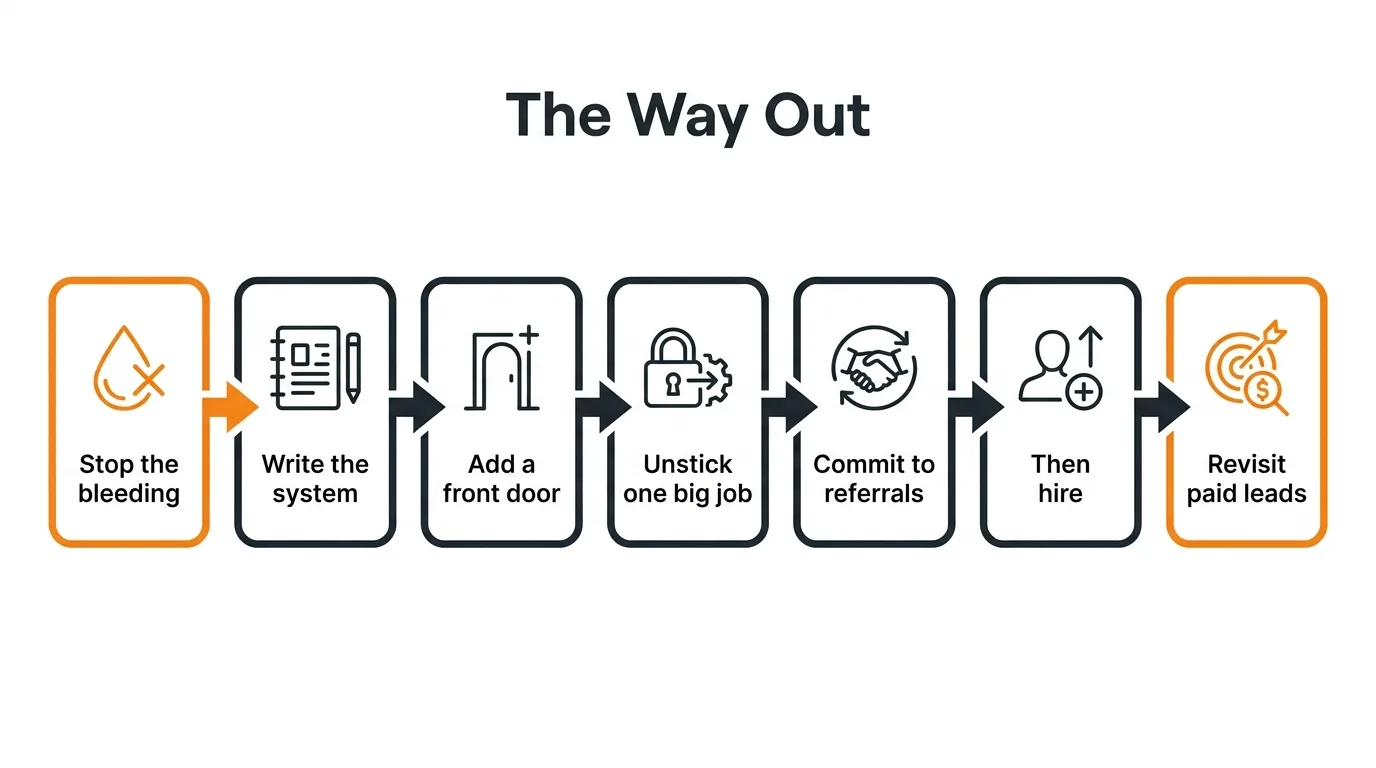
Build the system first, and the contradiction dissolves:
- Stop the bleeding. Pause the paid shared leads. Every dollar spent on a race you are set up to lose is a dollar not spent on the machine.
- Write the operating system. Standard scope definitions and pricing per job type. A deposit policy. A written estimate and signed agreement before work starts. An on-site scope-change policy: if the job inflates, the price inflates, in writing, on the spot. A dispute policy: what happens, in what order, when a customer objects.
- Add a front door. Screen customers before committing. Build a “no” policy. Turn down work that does not fit.
- Unstick one big job. Pick one of the stalled signed jobs and define a concrete start plan, or renegotiate the timeline with the customer.
- Commit to the referral channel. Regular attendance, consistent one-on-ones, and making referrals, while the operating system makes incoming referrals land smoothly.
- Then, and only then, hire. Hire people into the system, not into the chaos.
- Revisit paid leads only once response speed and conversion are demonstrably good.
The sweet spot
Most businesses never find it. The ones that do are the ones that fix the machine before they buy more fuel.
The contractor in this story is not a victim of any of it. He is a skilled operator who solved the hardest problem first, demand, and is now paying tuition on the second problem, operations. The marketplace is a mirror. The networking group is asking for consistency he has not committed to yet. And the customers who play games are not a sign he is in the wrong business. They are a sign the business needs a front door.
Once the business runs on the system instead of on him, the conflict dissolves: he can hire people into the system, the big jobs can start, and the business stops being his pain in the neck, without ever needing to become someone else’s.
That is the sweet spot: a business that works well enough to keep, but not yet well enough to scale. And the only way through it is the unglamorous one, paper, policy, and a “no.”
I could be wrong about the specifics of his situation. I have only had one conversation with him, and one conversation is a thin basis for a diagnosis. But the structure of the trap is common, and I have seen it in a lot of owner-operated businesses. If this matches what you see in your own business, or in one you are trying to help, I welcome the conversation. Help me check my thinking.
Sources
- Thumbtack Help, “How much do I pay for leads and opportunities?” and “How to set my lead prices”
- Thumbtack professional community forums, on shared-lead billing and response competition
- Contractor lead-cost reviews, 2025 to 2026, on per-lead pricing and conversion rates