When the Measuring Stick Lies, Good People Stop Trying
Distorted cost accounting in public institutions does not just produce bad budget decisions. It produces learned helplessness in the people who manage those budgets. The system, not the people, is the cause.
TL;DR
When budget measures systematically misrepresent which services strengthen and which weaken the system, the people managing those budgets cannot learn from their own decisions. Effort does not produce improvement. Over time, rational, competent professionals stop looking for internal solutions and focus entirely on external rescue. This is not a character flaw. It is learned helplessness, and the measuring stick is the cause.
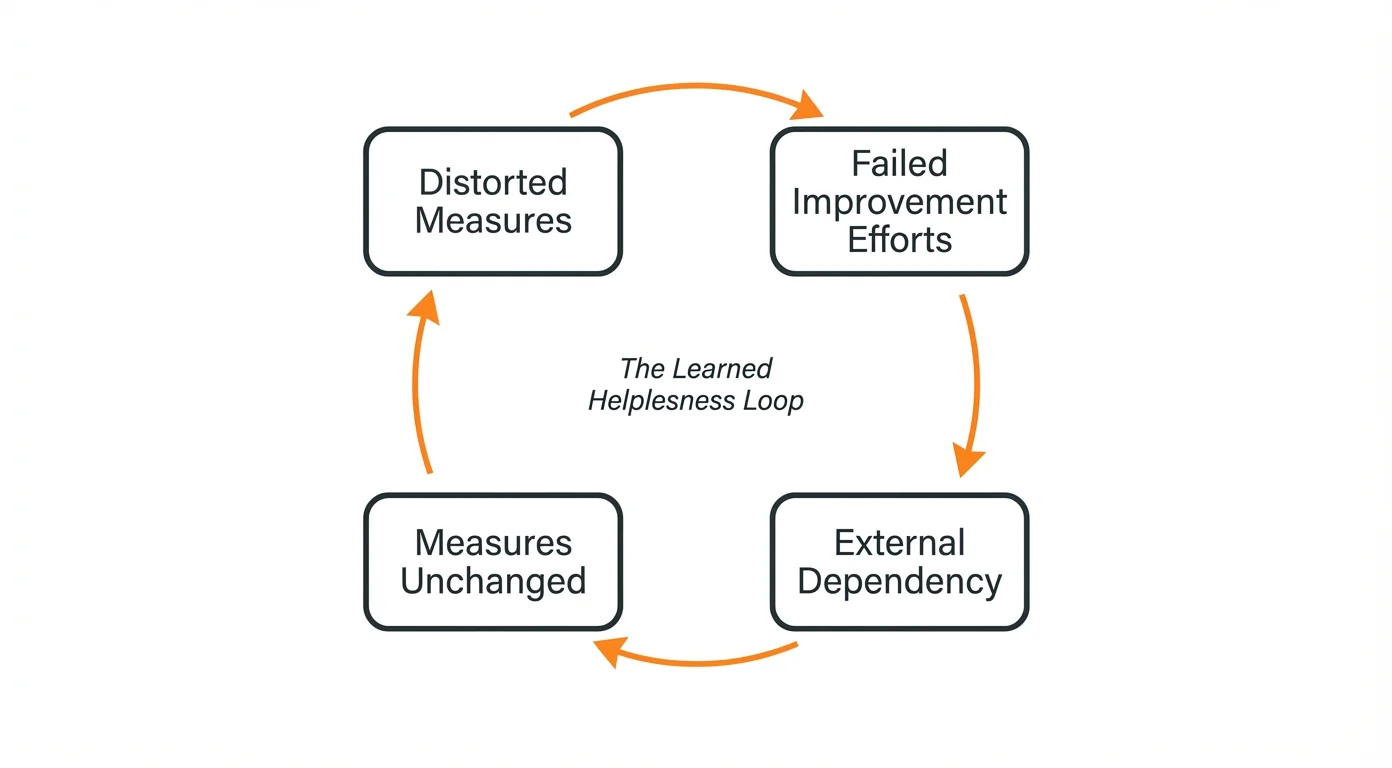
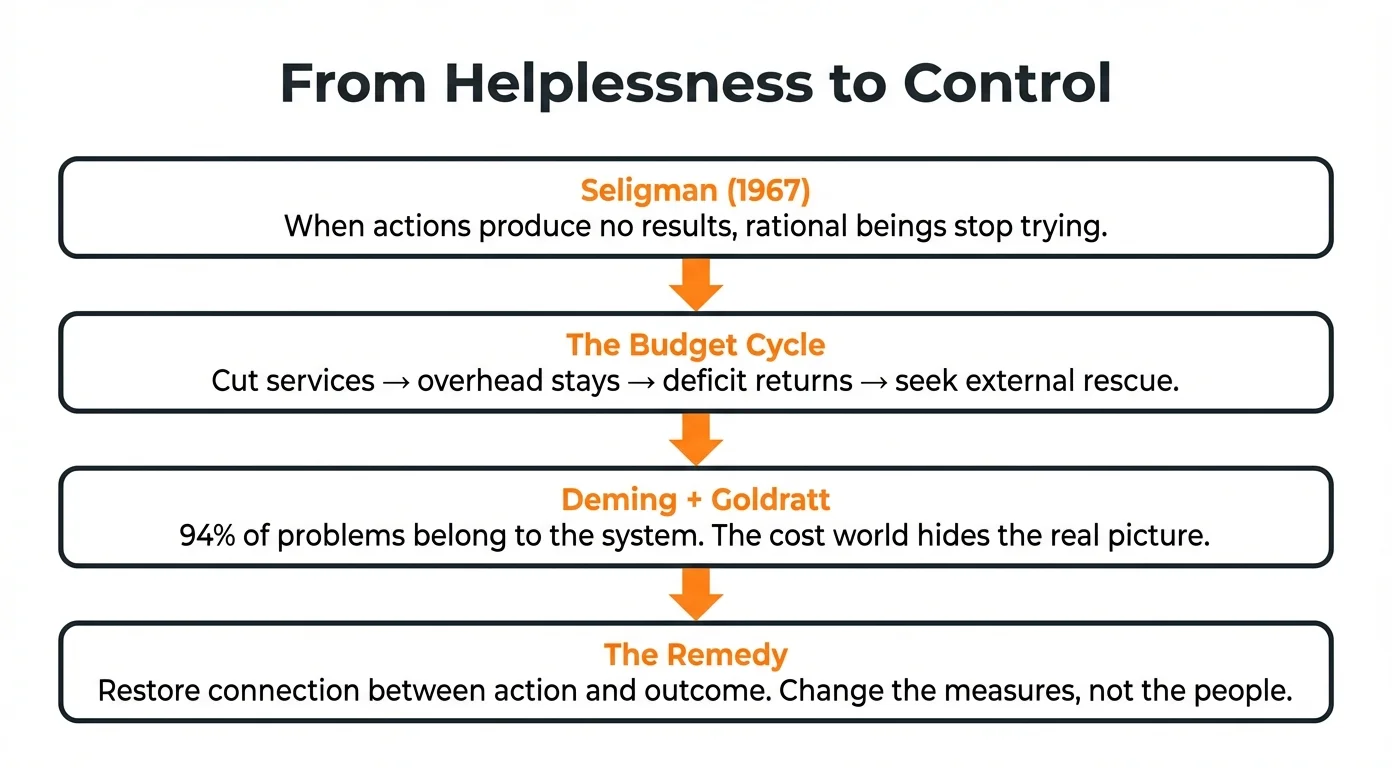
In a companion article, I described how standard cost allocation produces a specific distortion in public institution budgets: fixed overhead gets spread across service lines, making some look like losers. Cutting the “losers” does not remove the overhead. New taxes close the gap. The cycle repeats.
That piece focused on the financial mechanics. This one is about what happens to the people inside the cycle.
What Seligman discovered about inescapable feedback
In the late 1960s, psychologist Martin Seligman ran a series of experiments that became foundational to our understanding of motivation and depression.[1] The setup was simple. One group of animals could stop an unpleasant stimulus by taking action. A second group received the same stimulus but had no way to control it. Later, both groups were placed in a new situation where escape was easy and obvious.
The first group escaped quickly. The second group did not even try.
Seligman called this learned helplessness. The animals in the second group had not become stupid or lazy. They had learned, accurately, that their actions made no difference. When the situation changed and action could have helped, they could not unlearn the lesson fast enough to see it. The finding has been replicated extensively across species and in human experiments, where uncontrollable noise produces the same pattern of passivity that uncontrollable shock produces in animals.[1]
The critical finding, clarified by decades of subsequent neuroscience: passivity is not something organisms learn. It is the default response to prolonged aversive conditions. What organisms actually learn is control, the experience that their actions produce results. When that learning is blocked or reversed, the default passivity returns.[2]
This has profound implications for anyone managing a system where the feedback is broken.
The budget director who has seen this movie before
Consider the experience of a senior budget analyst at a large county. She is competent, experienced, and committed to public service. She has been through four or five budget cycles. Here is what each one has taught her:
A deficit appears. She identifies the service lines that appear to be net drains on the General Fund, based on the cost allocation model her organization has used for decades. She recommends reductions. The council approves some of them. The services are cut or scaled back.
The following year, the remaining service lines look more expensive than before. The overhead that was allocated to the cut services did not disappear. It got redistributed. The deficit is roughly the same size, or larger. Her analysis was technically correct within the framework she was given. The outcome was the opposite of what the analysis predicted.
She does this again. Same result. And again. Same result.
At some point, a reasonable, intelligent person draws a conclusion: internal optimization does not work. The problem is structural. It is beyond our control. The only solution is new revenue from the state legislature or the voters.
That conclusion is partially true. The 1 percent property tax cap is a real external constraint. The limited revenue tools available to counties are a real structural disadvantage compared to cities and the state. These are facts.
But the conclusion also contains a hidden assumption: that the internal decision framework is sound, and the problem lies entirely outside it. Nobody re-examines the measuring stick. Why would they? It is the standard methodology, used by every county in the state, validated by auditors, consistent with governmental accounting standards. The measuring stick is above suspicion.
The language of learned helplessness
You can see this dynamic in King County’s own public budget documents. They are refreshingly candid about the situation, and I respect that candor. But the framing tells a story about where the locus of control is perceived to be.
Their budget basics page states plainly that the structural gap between revenues and costs “can be resolved only through the collaboration of the State Legislature, counties, and voters.” Their myths and realities page notes that the county “has cut nearly every expense from the General Fund that is not mandated by state law.” Their 2025 budget executive summary describes the budget as “not sustainable” and projects that “very large budget reductions” will follow without “meaningful new revenue.”
Every sentence is accurate. And every sentence points outward. The problem is the revenue cap. The solution is the legislature. Internal action has been exhausted.
These are the honest conclusions of people working inside a system where effort does not produce visible improvement. They have optimized, cut, tightened, and restructured, and the picture never gets better. The rational next step is to stop believing that internal action can help and to focus entirely on external relief.
That is learned helplessness. Not the pathological kind. The rational kind. The kind that emerges when smart people are trapped in a feedback loop that never rewards their effort.
What Deming and Goldratt would say
W. Edwards Deming spent decades arguing that when performance falls short, the instinct to blame people is almost always wrong. He estimated that roughly 94 percent of problems belong to the system, not to the individuals working within it.[3] His point was not that people are blameless in some abstract moral sense. His point was practical: if you want improvement, work on the system. Blaming the people who are responding rationally to a broken system will never produce a different result.
Eli Goldratt, the founder of Theory of Constraints, made a complementary argument. He distinguished between the “cost world” and the “throughput world.” In the cost world, every service line carries a share of overhead, and the goal is to minimize total cost. In the throughput world, the goal is to maximize what the system generates above its truly variable costs, focused on the system’s binding constraint.
The cost world produces local optima that degrade global performance. You cut the “expensive” service line, and the system gets weaker. You do it again. Same result. The throughput world produces global optima by asking a different question: which services generate the most value per unit of the scarce resource that actually limits us?
When budget professionals are given only cost-world tools, they can only produce cost-world answers. The answers are internally consistent, methodologically sound, and often wrong at the system level. The professionals are not failing. The framework is failing them.
The compounding damage
The financial cost of this cycle is significant but hard to pin down precisely. King County has enacted multiple new revenue measures over the past decade to close gaps created by this pattern: a new 0.1 percent sales tax, expanded hospital levies, shifted funding sources for public health clinics. Each one addressed the immediate deficit. None changed the underlying dynamic.
But the deeper damage is to the institutional capacity for learning. When measures are distorted, organizations cannot learn from their own decisions. Every budget cycle confirms the same lesson: we tried, it did not work, the problem is external. That lesson accumulates. It shapes culture. It determines which questions get asked and which do not.
A budget team that has lived through this cycle five times is not going to propose a fundamentally different analytical framework on the sixth try. They are going to propose new revenue. Not because they lack imagination, but because experience has taught them, repeatedly, that internal action does not correlate with improvement. The feedback loop is broken, and they do not know it is broken because the methodology that produces it is considered standard and sound.
This is what makes learned helplessness so insidious in organizational settings. It does not look like giving up. It looks like pragmatism. It looks like experience. It looks like the senior people in the room being realistic about what can and cannot be changed.
What restores the sense of control
Seligman’s research also pointed to the remedy. Learned helplessness is not permanent. It reverses when the subject experiences that their actions produce results. In his experiments, physically guiding the animals through the escape action was enough to break the pattern. Once they experienced control, even briefly, they could act on it again.
The organizational equivalent is changing the measures so that effort becomes visible.
If a county budget team ran a parallel analysis, contribution margin before overhead allocation for each major service area, they would see a different picture. Some services they have been cutting might turn out to be net cash contributors. Others they have been protecting might turn out to consume more of the scarce constraint than they return. For the first time, the team would have a measure that responds to their decisions in a way that makes sense.
That experience, seeing that a different lens produces a different and more accurate picture, is the equivalent of Seligman’s guided escape. It does not solve the revenue cap. It does not eliminate the structural gap. But it restores the connection between action and outcome. It gives the budget team something they can actually affect.
And that changes everything. Not because the numbers are magical, but because people who can see the effect of their decisions start making better ones. The passivity breaks. The creativity returns. The questions change from “how do we close this gap?” to “which services are actually strengthening the system, and how do we do more of that?”
This is not about blame
I want to be explicit about something. Nothing in this analysis is a criticism of the people who manage King County’s budget, or any other county’s budget, or any public institution caught in this cycle. These are skilled professionals doing hard work with the tools they have been given. The tools are standard. The methodology is sanctioned by every auditing body in the country. There is no reason for anyone inside the system to suspect that the measuring stick itself is part of the problem.
The blame, if there is any, belongs to the methodology. Cost allocation is a powerful tool for a specific purpose: ensuring that shared costs are distributed fairly across the entities that benefit from them. It was never designed to guide service line strategy. Using it for that purpose produces predictable distortions, and those distortions produce predictable behavioral responses in the people who rely on them.
Deming said that the system produces the results. Goldratt said that the constraint determines the performance. Seligman said that when effort and outcome are decoupled, passivity follows. All three are describing the same phenomenon from different angles.
The fix is the same in all three frameworks: change the system that people work in, not the people who work in the system. In this case, that means supplementing cost-world measures with throughput-world measures so that the people making decisions can see the actual effect of those decisions on the system’s health.
An invitation
If you work inside a public institution budget process and you recognize this pattern, the sense that internal action has been exhausted and only external rescue can help, I would genuinely like to hear about it. Not to prove a point, but to understand whether this framing matches reality as you experience it.
If it does, the companion article on the cost-allocation trap includes a diagnostic prompt you can run in minutes. It will not solve the problem. But it may change which questions you ask next. And that, in Seligman’s framework, is how learned helplessness begins to break.
You can reach me at john@common-sense.com. I welcome the pushback as much as the agreement. Both help.
References
1. Seligman, M. E. P., & Maier, S. F. (1967). Failure to escape traumatic shock. Journal of Experimental Psychology, 74(1), 1-9. The original experiments have been replicated across species (dogs, rats, cats, fish, humans) and across laboratories worldwide over five decades. Human replications include Hiroto, D. S., & Seligman, M. E. P. (1975). Generality of learned helplessness in man. Journal of Personality and Social Psychology, 31(2), 311-327.
2. Maier, S. F., & Seligman, M. E. P. (2016). Learned helplessness at fifty: Insights from neuroscience. Psychological Review, 123(4), 349-367. This fifty-year retrospective by the original researchers reversed the theoretical mechanism: passivity is the default, unlearned response to prolonged aversive events; what organisms learn is control. The behavioral findings of the original experiments were confirmed; the explanation of why was updated. See also Baratta, M. V., Seligman, M. E. P., & Maier, S. F. (2023). From helplessness to controllability: toward a neuroscience of resilience. Frontiers in Psychiatry, 14, 1170417.
3. Deming, W. E. (2000). Out of the Crisis (2nd ed.). MIT Press. p. 315. The original reads: “I should estimate that in my experience most troubles and most possibilities for improvement add up to the proportions something like this: 94% belongs to the system (responsibility of management), 6% special.”