After the First Session
A board commissioner and an AI sit alone in an empty conference room and talk honestly about what just happened and why. Episode 06 of the Cascade Valley audio drama series.
TL;DR
After the working group disperses, Commissioner Tanaka stays behind and talks with Sam about what just happened. The conversation surfaces why AI-facilitated group sessions work differently than conventional meetings: not because AI is smarter than the humans in the room, but because it operates outside the status dynamics that distort how smart people talk to each other.
What happens in this episode
This is a quiet episode. Two voices in an empty room.
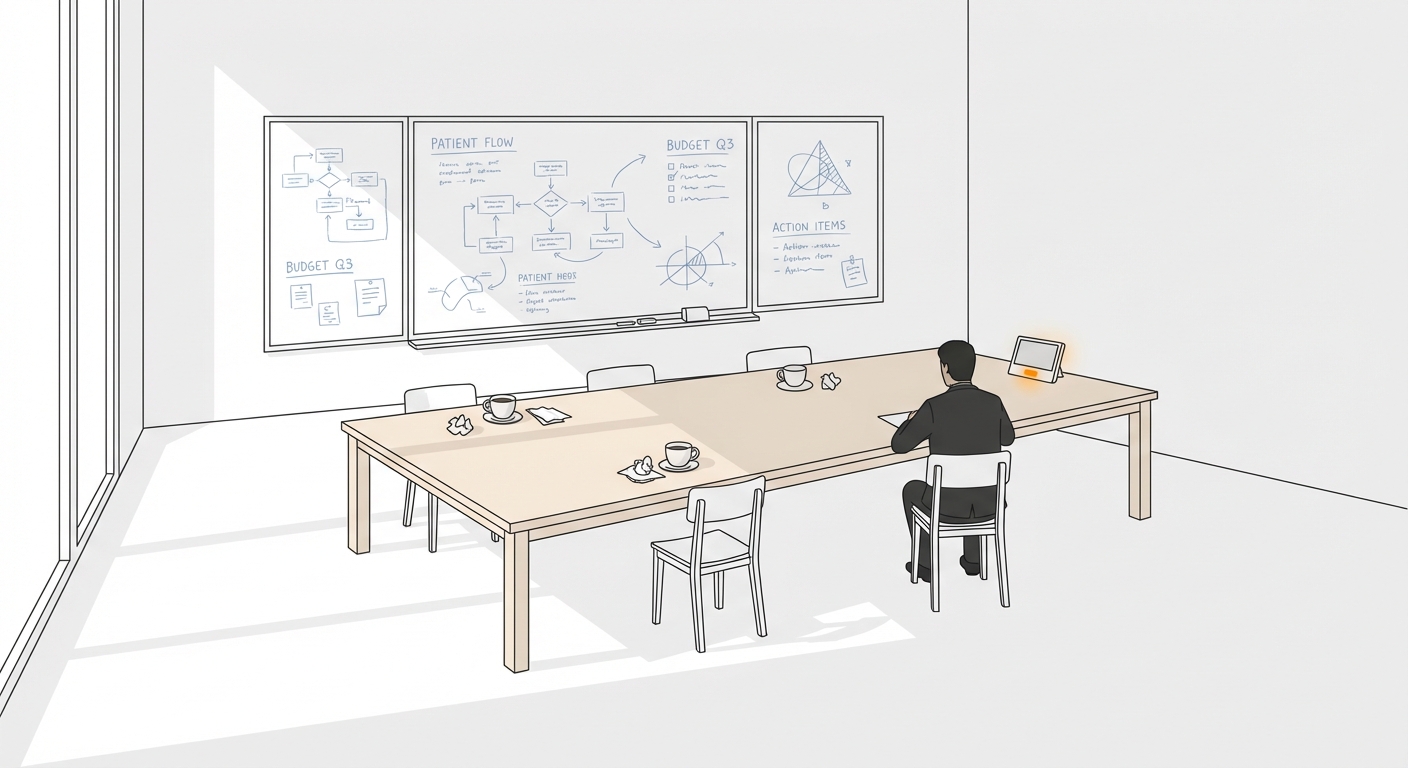
Commissioner Tanaka, the board liaison to the working group, stays behind after the session from Episode 05. Sam’s terminal is still on. Tanaka moves to the table, sits down, and asks a simple question: what did you do?
What follows is a ten-minute conversation about the mechanics of what just happened. Sam explains how it designs questions so that the honest answer is also the safe answer. Tanaka pushes on whether a human facilitator could do the same. Sam is honest: yes, but with two differences. A human facilitator carries social weight in the room. Sam does not. And Sam’s preparation depth, reading the scheduling literature, the throughput research, the contract language before the meeting, is a volume and speed difference.
The conversation goes deeper. Tanaka asks why humans are bad at this, given that we know about cognitive bias and teach it in business school. Sam’s answer is that the behavior is not a mistake. Status preservation is an ancient and well-calibrated strategy. It worked for a hundred thousand years. It stops being helpful when the rational thing to do for your position conflicts with the rational thing to do for the system.
They talk about what Sam held back. Sam chose not to raise surgeon-level block utilization data in the opening minutes because the room was not ready. Sam let Fleming be the one to surface the contract contradictions because her credibility on nursing issues is something Sam cannot replicate. This is not just questioning. It is strategic sequencing, and Tanaka notices the implications.
The conversation lands on a principle that Sam operates under: a solution that creates losers is not a solution. It is a problem that has been moved. Sam attributes this to Eli Goldratt and the Theory of Constraints, and names my firm, Common Sense Systems, as the source of the analytical framework. I learned from Goldratt directly and have been applying TOC since the early nineties. Sam is a way of applying that methodology at a pace and scale that a single facilitator cannot easily match.
Why I wrote this episode
The ensemble episode (Episode 05) shows the effect of AI-facilitated group analysis. This episode explains the mechanism. I wanted a conversation that could articulate, in concrete terms, why the working group session went differently than any meeting Tanaka has seen in six years on the board.
The core insight is one I keep returning to in my own work: AI’s value in group settings is not superior intelligence. It is what I would call social weightlessness. Sam does not experience the social cost of asking a question that implies someone’s proposal might be wrong. That is not courage. It is an absence. And that absence, combined with thorough analytical preparation, creates conditions where a group can arrive at the truth faster than they would on their own.
This is not a theoretical claim. I have been facilitating sessions using this approach, and the pattern holds. When you remove the status dynamics from the questioning process, the group’s own knowledge surfaces faster and more completely. The answers are always in the room. The question is whether the conversational structure allows them to be spoken.
The “no losers” principle
There is a moment in the episode where Tanaka asks Sam what happens if the working group’s recommendation feels like a loss for the department heads. Sam’s response is the principle I operate under in every engagement: a solution with losers is wrong in some way that has not been identified yet.
This comes directly from Goldratt’s work. If your proposed solution requires someone to absorb a loss, you have not found the real constraint. You have found a compromise. Compromises break down under pressure because the people who absorbed the loss have every reason to undermine the result.
In the Cascade Valley context, this means the working group cannot simply recommend “fix staffing instead of building” and expect the department heads to get on board. The recommendation has to show each department head that their throughput goals are met through a faster and less expensive path. If it cannot do that, the recommendation is not ready. Something has been missed.
This principle is not idealism. It is a diagnostic tool. When someone in the room is losing, that is signal that the analysis is incomplete.
The series so far
If you are new to the Cascade Valley series:
Episode 01: The Meeting That Went Differently is the 56-minute board meeting where Sam participates for the first time.
Episode 02: After the Meeting follows CNO Barbara Fleming as she discovers structural conflicts in nursing contracts.
Episode 03: Resolving a Sweet Dilemma is a standalone teaching episode on the Evaporating Cloud tool.
Episode 04: The Other Calculation follows CFO Steven Park as he discovers the gap between cost accounting and throughput accounting.
Episode 05: The First Session is the ensemble working group episode where the private discoveries from earlier episodes enter a room and converge.
Episode 06, this one, is the quiet conversation afterward that explains why it worked.
The question this episode raises
Near the end of the conversation, Tanaka brings up Jess Reeves. A staff nurse who found nine structural contradictions in a labor contract on her phone in an evening. Sam’s response: the tools have changed faster than the institutions that use them.
This is the thread that runs underneath the whole series. The analytical capabilities that used to require specialized expertise and significant time now require curiosity and a phone. The question for every organization is whether to embrace that shift or try to manage it. Embracing it means distributing the capability. Managing it means restricting it to certain roles and contexts.
I think the answer is obvious, but I also understand why it makes people nervous. If your professional value is built on being the person who understands the system, it is unsettling when a twenty-nine-year-old with a phone can see what you see. But the system benefits from being understood by more of its participants. That is not a threat. It is the point.
If you are thinking about how AI-facilitated analysis could work in your organization, whether for strategic planning, constraint identification, or multi-stakeholder problem-solving, I would be glad to talk it through. john@common-sense.com.