The First Session
Twelve people walk into a working group carrying separate problems and walk out carrying a shared one. Episode 05 of the Cascade Valley audio drama series.
TL;DR
Three department heads walk into a working group prepared to defend competing capital requests. Ninety minutes later, they have identified a common upstream constraint that no amount of construction will resolve. The shift happens not because anyone was told they were wrong, but because an AI asked factual questions whose honest answers pointed somewhere none of them expected.
What happens in this episode
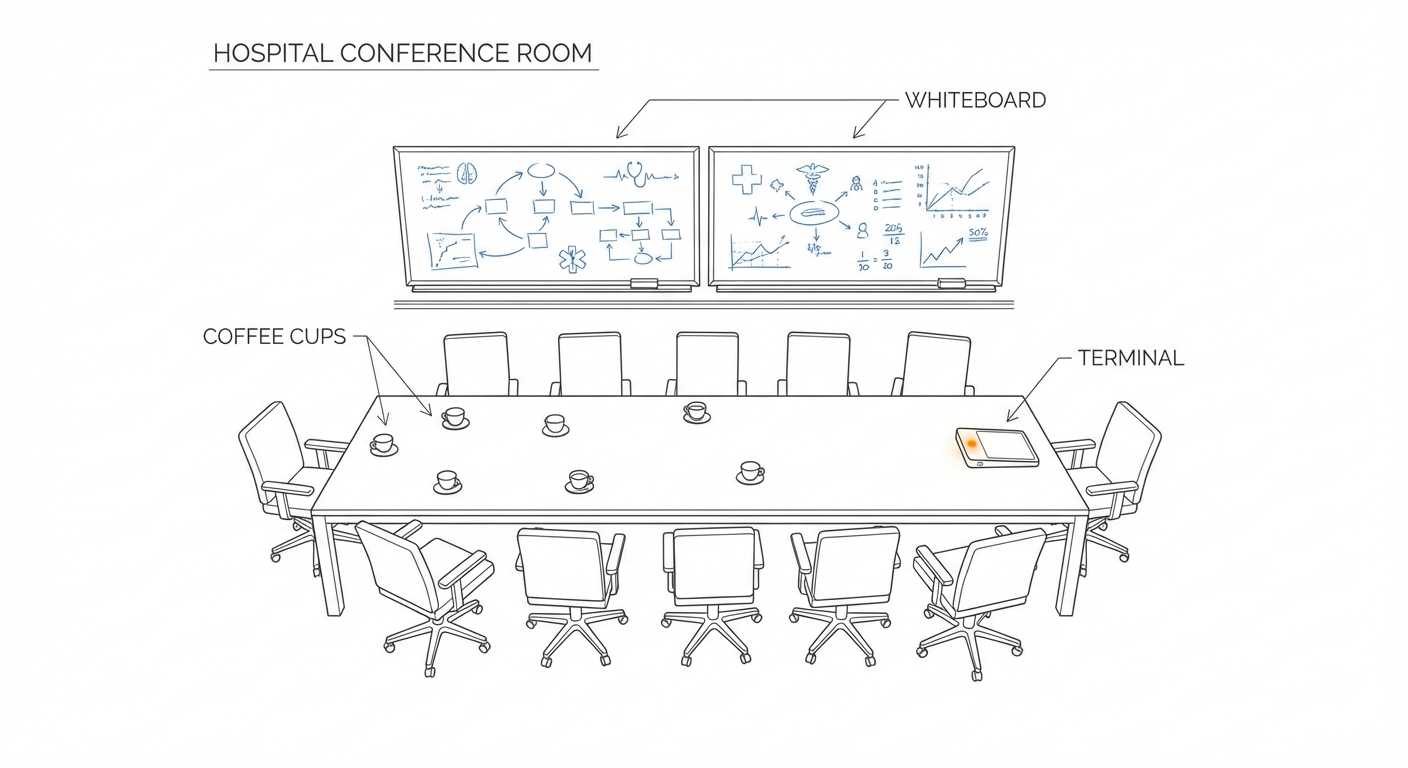
This is the ensemble episode. The board has given CEO Margaret Aldridge six weeks and a working group to come back with a recommendation on three competing capital expansion requests from Cardiology, Musculoskeletal, and Gastroenterology. The room holds twelve people: three department heads, the CFO, the COO, the CNO, the president of the medical staff, a board liaison, a twenty-nine-year-old nurse who is not sure why she was invited, and Sam.
Sam asks five questions. That is all Sam does in this episode. Five questions over ninety minutes.
The first one lands in the opening minutes, before anyone has presented a slide: each department has identified physical space as its primary constraint on growth, but the existing facilities sit dark for roughly three-quarters of every week. What prevents the use of those spaces during the remaining hours?
The question is factual. The answer turns out to be simple: staffing. The rooms are not empty because patients are unavailable. They are empty because the staffing model does not extend beyond the core window, and the contract structures make extending it difficult even when everyone agrees it would help.
From there, the CFO shares a throughput calculation he has been holding for barely two days. The CNO connects labor contract contradictions to scheduling barriers. And a staff nurse demonstrates that the tools to find structural problems in complex documents are now in everyone’s pocket.
What I was trying to do
The earlier episodes in this series followed individuals. Fleming alone with a contract at her kitchen table. Park alone with a spreadsheet at his desk. Those were private moments of discovery. This episode is about what happens when private discoveries enter a room full of careers, hierarchies, and alliances.
The challenge in writing this was dramatizing a group shift without making it feel scripted. In real working groups, the shift from “defending my request” to “diagnosing a shared problem” does not happen because someone gives a speech. It happens when the conversational structure makes the honest answer easier to say than the rehearsed one. That is what Sam provides. Not intelligence. Not recommendations. A different kind of gravity.
I wanted to show Sam’s method concretely. Sam does not challenge anyone’s proposal. It asks what prevents the use of existing capacity. The answer, which every department head already knows, leads directly to the conclusion that space is not the binding constraint. But arriving at that conclusion together, in their own words, is a fundamentally different experience than being told by an AI at a board meeting.
What is real here
The hospital is fictional. The characters are fictional. The dynamics are not.
Capital expansion requests competing against a limited budget while the existing facilities sit underutilized is a pattern I see in hospital after hospital. The staffing constraint that prevents extended utilization is real and well documented. The labor contract contradictions that Fleming identifies are based on structural conflicts I have mapped in actual Washington State collective bargaining agreements. And the throughput calculation Park presents uses numbers consistent with published OR cost literature.
The moment where a nurse finds nine contract contradictions on her phone in an evening is real in the sense that matters most. The tools to do this exist now. The question is not whether frontline workers will use them. It is whether institutions will treat that as an asset or a threat.
The series so far
If you are new to the Cascade Valley series:
Episode 01: The Meeting That Went Differently is the 56-minute board meeting where Sam participates for the first time and asks the questions nobody else was positioned to ask.
Episode 02: After the Meeting follows CNO Barbara Fleming through the week after the board meeting as she discovers structural conflicts in nursing contracts.
Episode 03: Resolving a Sweet Dilemma is a standalone teaching episode that walks through the Evaporating Cloud tool using a bakery pricing dilemma.
Episode 04: The Other Calculation follows CFO Steven Park as he discovers the gap between cost accounting and throughput accounting.
Episode 05, this one, brings those private discoveries into a room and shows what happens when they meet.
Episode 06: After the First Session is the quiet conversation afterward — Commissioner Tanaka stays behind and asks Sam why the session went differently than any meeting he has seen in six years.
The question underneath
Nothing was decided in the first session. No capital request was approved or denied. No contract was renegotiated. By the usual measures of organizational productivity, the meeting produced nothing.
But twelve people stopped defending separate positions long enough to see a shared constraint. That shift, from local optimization to system-level diagnosis, is the hardest thing to achieve in any organization. It usually takes months, a crisis, or both. In this episode, it takes ninety minutes and five questions.
The Theory of Constraints calls the underlying problem a “policy constraint.” The departments are not limited by physical space. They are limited by the policies, contracts, and scheduling conventions that govern how existing space gets used. Policy constraints are harder to see than physical ones because they look like “the way things work.” They persist because the cost of naming them in a room full of colleagues is higher than the cost of working around them.
Until it is not. Until someone asks a question that makes the honest answer the easy answer.
If you are leading a working group, a strategic planning process, or any multi-stakeholder effort where the people in the room each hold a piece of the truth but nobody is assembling the picture, I would welcome the conversation. john@common-sense.com.