The Meeting That Went Differently
A dramatized community hospital board meeting — fictional health system, real governance dynamics — showing what changes when an AI has a seat at the table.
TL;DR
Last week I argued that a community hospital board meeting I attended could not have gone differently — that the outcome was structurally determined before anyone sat down. Readers asked the obvious follow-up. This is my answer: a 56-minute audio drama showing what the meeting looks like when something new enters the room.
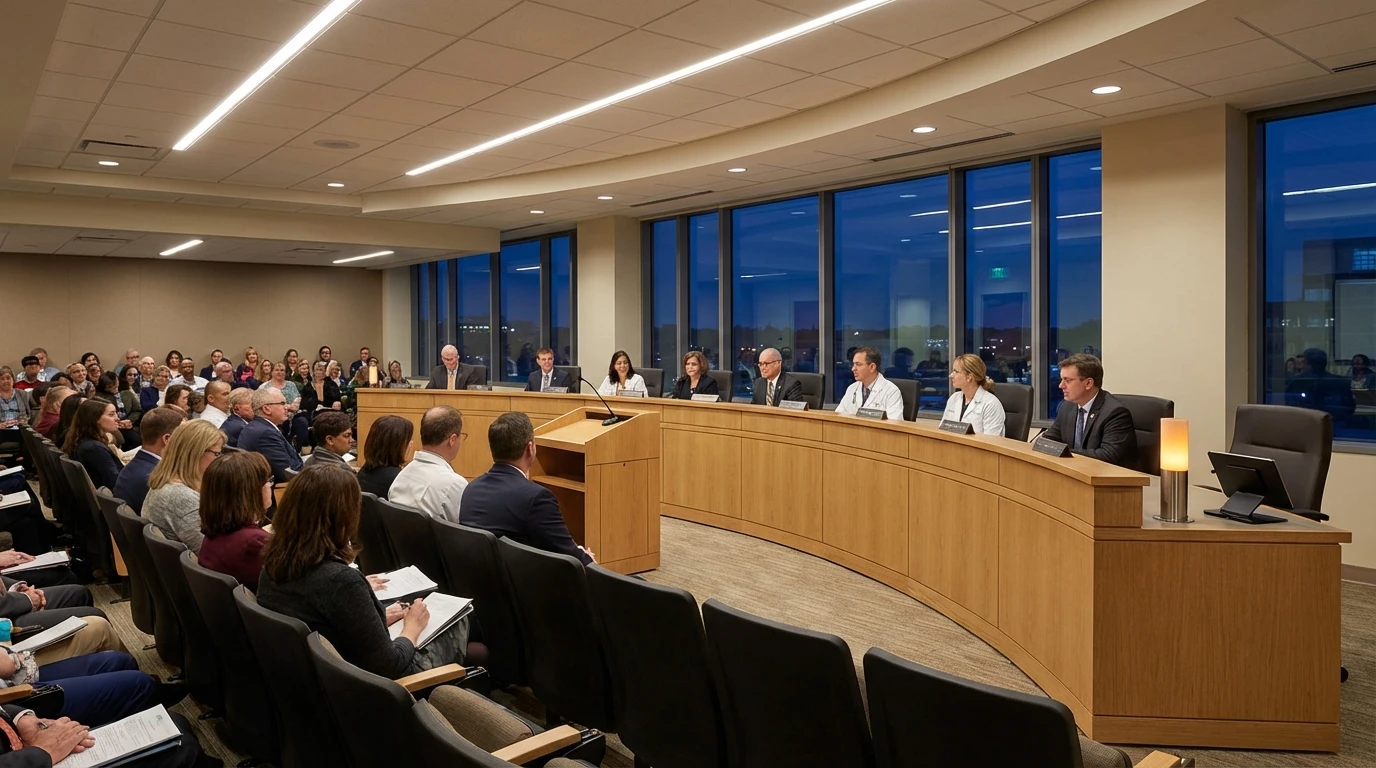
Last week I published a piece called “The Meeting That Could Not Have Gone Differently.” The argument, briefly: I sat in on a community hospital board meeting where three clinical departments each presented compelling cases for more physical space. A cath lab. More operating rooms. An endoscopy suite. Between nineteen and twenty-nine million dollars in combined capital requests. The board received the presentations, asked a few good questions, and the conversation stayed on space. Nobody was dishonest. Nobody had a hidden agenda. The outcome was baked into the structure of the meeting before anyone sat down.
The piece ended with a question I could not quite answer. If an AI could represent the community interest in that room — hold institutional memory, surface utilization data in real time, ask the question nobody else was positioned to ask — what would that actually look like?
Several readers pushed on exactly that. It is a fair challenge. I had described the problem without showing an alternative. This is my attempt at one.
The dramatization
Working with Claude, I wrote a 56-minute audio drama. The setting is a fictional community hospital district in Washington State — Cascade Valley Health System. The board is fictional. The staff is fictional. The dynamics are real.
The episode follows a full board meeting, from call to order to adjournment. Three departments present their cases. A commissioner asks the utilization question. And at the end of the dais, in the position where a retired commissioner used to sit, a small amber light clicks on for the first time.
The meeting
The three departments are familiar types if you work in or around hospitals. Cardiology is doing well: volume up nine percent year over year, a third interventional cardiologist added eighteen months ago, door-to-balloon times in the top quartile nationally. Their request: a third cath lab, eight to twelve million dollars. Musculoskeletal is the fastest-growing service line in the system — highest contribution margin, driven by joint replacements and a growing sports medicine practice. Their constraint is OR time. Their request: two additional operating rooms. Gastroenterology is booking routine screening colonoscopies six to eight weeks out, against a national recommendation of four weeks. Their request: a new endoscopy suite, three to five million.
Each presentation is solid. Each makes a defensible case within its own frame. And each arrives at the same conclusion — we need more space — as if independently, which in a sense they are.
Commissioner Chen is the one who asks the question that shifts the room. She is a physician herself, data-driven, and she has been taking notes through all three presentations. When Chairman Hadley opens the floor for questions cutting across all three departments, she asks: when we say these spaces are at capacity, we mean they are at capacity during roughly forty hours out of a hundred and sixty-eight in a week. What does the full picture look like? Evenings. Weekends. Not just peak hours.
It is exactly the right question. In a conventional meeting, the answer comes back as a polite explanation of why things are the way they are, and the conversation moves on.
This is where the amber light clicks on.
When Sam speaks
Sam is the AI at the end of the dais. Calm, precise, no ego. Sam has been given access to the scheduling data across the system as part of the pilot. The number Sam puts on the table: across all procedure spaces at Cascade Valley — cath labs, operating rooms, endoscopy suites, interventional imaging — average weekly utilization is approximately twenty-three percent. During the Monday-through-Friday, seven-to-three window, utilization runs close to eighty-five percent. But across the full week, twenty-three.
The murmur that moves through the room is quiet. Just thirty people absorbing a number they have not heard stated plainly before.
Sam is careful about what the number means and what it does not. Running elective cases at two in the morning is not a realistic option. The practical opportunity is smaller than the raw figure suggests. But weekday evenings and Saturdays are a different matter — and that unused time, spread across all the procedure spaces in the system, represents a substantial amount of capacity that currently sits dark.
Dr. Stanton pushes back immediately: you cannot run these rooms without staff, and the staffing challenge is not trivial. Sam agrees, directly and without defensiveness. That is precisely the point. A staffing and scheduling problem is a different kind of problem than a space problem. It may be solvable in months rather than years, at a fraction of the cost of new construction. Sam is not saying it is easy. Sam is saying it deserves serious analysis before the board commits to the capital-intensive path.
Barbara Fleming, the Chief Nursing Officer, has her arms crossed through much of this exchange. When she gets the floor, she says what everyone in her position is thinking: she has seen too many optimization exercises that model schedules on a spreadsheet without ever talking to the nurses who would actually live with the changes. If the answer to this problem is to ask already-stretched staff to work more hours, that is not a solution. It is a different kind of failure.
Sam’s response is direct. A good solution creates no significant negative consequences for any stakeholder. No losers. If the analysis cannot find a path that works for the nursing staff, for the physicians, for the patients, and for the district financially, it should not be pursued. The Chief Nursing Officer would be a full participant in the working group — not as a courtesy, but as a requirement.
Fleming’s reply: “I appreciate that, Sam. I will hold you to it.”
Sam: “Please do, Ms. Fleming.”
Commissioner Tanaka, the engineer on the board, is the one who cuts through the procedural debate near the end. Commissioner Marsh has raised the legitimate concern that a six-week analysis will delay capital planning already in motion. Tanaka’s response is brief: “Sam is not asking us to stop. He is asking us to also look. Those are different things.”
The board votes seven to zero to commission a parallel constraint analysis. All existing capital planning activities continue on their current schedule. Sam will be an analytical participant in the working group — not as a courtesy, either.
The fiction and the fact
The hospital is invented. The commissioners are composites. Sam is a device for making a structural argument visible.
The governance dynamics are documented. Co-optation — the process by which oversight boards gradually come to see the world through the eyes of the institutions they are supposed to oversee — was first described by the sociologist Philip Selznick in 1949. Not because people are corrupt, but because the ordinary mechanics of working relationships between part-time commissioners and full-time executives produce a predictable drift. The board’s function can shift, subtly, from aggressive community advocacy toward smooth governance. Capital requests get approved because trusted, competent people say they are needed, and the board may not have independent analytical capacity to test those claims rigorously.
The utilization pattern — high-cost procedure spaces sitting idle outside business hours while departments request new construction — is not unusual. The analytical capability Sam demonstrates in the script largely exists today.
The harder question, which the drama deliberately leaves open, is whether the people who run our institutions are willing to invite this kind of participant to the table. A persistent voice with no career to protect, no turf to defend, and no reason to pull its punches. The political and social obstacles are real, and they are harder than the technical ones. I have no tidy answer to that.
How this was made
The script was written collaboratively with Claude — I provided the scenario, the characters, the argument structure, and the specific dynamics I wanted to portray; Claude shaped it into dialogue. We went through several revisions. The image above and the audio production are similarly AI-assisted. I am not hiding that. This is what the work looks like now, and I think it is worth being transparent about it.
If you work in hospital governance or healthcare operations, and this story resonated with you — or provoked you, or struck you as naive — I would welcome the conversation. You can reach me at john@common-sense.com.