How a Print Shop Found 35% More Capacity in a Week
A fine art printing company in Kent, WA was drowning in rework and backlog. The constraint was obvious once we looked: the graphic artist was doing every job twice. A pre-flight checklist and a simple scheduling change fixed it.
TL;DR
Northwest Fine Art Printing in Kent, WA had a graphic artist buried in rework because orders arrived incomplete. Adding a pre-flight check, choking work release, and reserving expedite slots recovered 35% more throughput in about a week. The backlog drained. The shop became easy to manage.
Northwest Fine Art Printing was a specialty shop in Kent, Washington. They produced fine art prints: gallery reproductions, limited editions, custom work for artists and photographers. The quality was excellent. The workflow was not.
When I walked through the shop, the first thing I noticed was the volume of work-in-progress stacked around the graphic artist’s station. Jobs in various states of completion. Notes taped to prints. A phone within arm’s reach because the artist was constantly calling customers.
The flow through the shop was chaotic. Orders came in, sat in a queue, and then hit the artist’s station, where the real production work happened: color correction, test prints, adjustments, proofing, final output. This was the skilled, time-consuming part. Everything upstream was clerical. Everything downstream was straightforward. The artist was where jobs either moved or stalled.
And they were stalling. Regularly.
The Problem Nobody Had Named
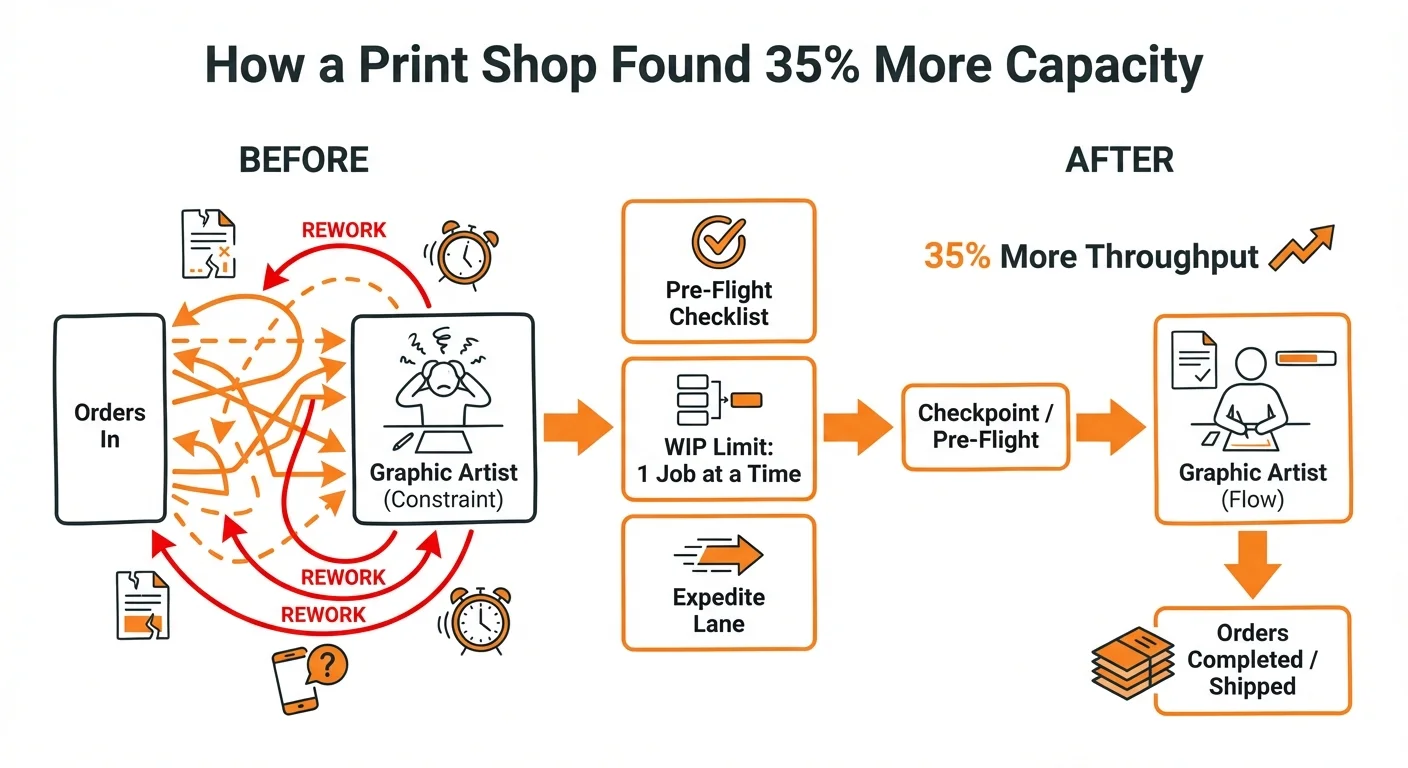
The artist was doing most jobs at least twice. Not because the work was bad, but because the inputs were bad. A customer would submit an order for a limited-edition print, but the file was the wrong resolution. Or the color profile was missing. Or the crop dimensions did not match the requested print size. Or the paper stock was not specified.
Each time this happened, the artist had to stop, figure out what was missing, contact the customer, wait for a response, and then restart the job when the information came back. Sometimes a single print went through three rounds of this before it could be completed.
Nobody had named this as the central problem because it felt like a dozen separate problems. This customer sent a bad file. That customer did not specify paper. The other customer changed their mind about cropping. Each incident was treated as a one-off. But the pattern was consistent: the artist, the most constrained resource in the shop, was spending roughly half of available capacity on rework caused by incomplete inputs.
In Theory of Constraints terms, they were wasting the constraint. The artist’s station was the bottleneck, the one resource that set the pace for the entire shop. Every hour the artist spent chasing missing information was an hour of throughput the shop would never get back.
The Fix: A Clerk with a Checklist
The first thing we did was add a pre-flight stage. Before any order reached the artist, a clerk reviewed it against a checklist. Was the file at the correct resolution? Was the color profile included? Were the dimensions specified? Was the paper stock selected? Was payment confirmed?
If anything was missing, the clerk called the customer and got it resolved before the order entered the production queue. The artist never saw an incomplete job.
I know it sounds low-tech. It was. A person, a checklist, a phone. But the effect was immediate. The artist stopped multitasking. Jobs stopped bouncing back. The rework that had been consuming half the constraint’s capacity simply disappeared, because the cause of the rework was no longer reaching the constraint.
Choking the Release
The second change was to control the rate at which work was released to the artist. Before, the queue was a pile. Everything that had cleared intake was sitting at the artist’s station, visible and urgent. The artist would try to work on two or three jobs at once, context-switching between them, which made everything slower.
We limited the work-in-progress at the artist’s station to one job at a time, with the next job staged and ready. When a job was completed, the next one moved in. The rest of the queue was held upstream, visible to the clerk but not to the artist. The artist’s job was to finish the current job, not to triage a pile.
In TOC terms, this is drum-buffer-rope. The artist (the drum) sets the pace. A small buffer of staged work protects the drum from starvation. And the release of new work into the system (the rope) is tied to the drum’s pace, not to the rate at which orders arrive.
The Expedite Lane
The third change was adding an expedited service. Customers could pay a premium to move to the front of the queue. We reserved a portion of the artist’s capacity for expedited orders. If no expedited work was waiting, the artist simply pulled the next standard job. This gave the shop a way to capture additional revenue from time-sensitive customers without disrupting the overall flow.
The Result
Flow through the shop improved by about 35% within the first week. Not because anyone worked harder. Not because we bought equipment or hired staff. Because we stopped wasting the constraint.
The pending backlog, which had been a permanent fixture, drained in days. Jobs that used to take a week to complete were moving through in two or three days. The artist, who had been stressed and constantly interrupted, was now working on one job at a time with everything needed to complete it. The shop became easy to manage because the flow was predictable.
It is a little embarrassing to admit how simple this was. A pre-flight check. A work-in-progress limit. An expedite lane. Nothing that requires a textbook or a consultant, really. But that is the thing about constraints: they hide behind the chaos they create. When every day feels like a new crisis, it is hard to see that the crises share a common cause. Once you name it, the fix is usually straightforward.
The Principle
This is the Theory of Constraints at its most basic. Every system has one resource that limits its throughput. Before you invest in expanding that resource, stop wasting it. Make sure it is never starved for inputs, never waiting on information it should already have, never drowning in work it cannot get to. Organize everything else in the system to keep the constraint running at full capacity on value-creating work.
For a more detailed walkthrough of the Five Focusing Steps and how they apply across different industries, see our Theory of Constraints reference page. If you are running a business where everything feels busy but nothing moves fast enough, the constraint is probably hiding in plain sight. I am happy to help you find it. Reach me at john@common-sense.com.