Your Website Looks Great. So Why Isn't the Phone Ringing?
You invested in a professional website. It gets traffic. It looks right. But the phone barely rings. The problem is not the website. It is what the website is saying.
TL;DR
If your website gets traffic but does not generate calls, the problem is almost never the website itself. It is that your site says the same thing as every competitor. Visitors compare you on the only dimension left: price and convenience. The fix is not better design. It is a better offer, one that speaks to a specific problem your best clients have and that your competitors are not solving.
David is an attorney. He left a mid-size firm two years ago to start his own practice, focusing on business law for small companies. He is good at what he does. His clients like him. The ones who find him tend to stay.
The problem is finding them.
He did what you are supposed to do. He hired a web designer. The site is clean, professional, mobile-friendly. He paid for SEO. He shows up on the first page for “small business attorney” in his metro area. The analytics show traffic. People are visiting.
But the phone barely rings. Maybe two or three inquiries a month from the website. Most of them are price shoppers looking for the cheapest LLC formation or a free consultation. The clients he actually wants to work with, owners of growing businesses who need ongoing counsel, do not seem to be finding him. Or if they are finding him, they are not picking up the phone.
David has tried the fixes his web designer suggested. A bigger “Contact Us” button. A chat widget. Testimonials. A blog. A lead magnet. None of them moved the needle more than slightly.
He is starting to wonder if the website just does not work for his kind of practice. Maybe he should spend the money on networking instead. Maybe referrals are the only thing that works for lawyers.
Referrals do work. But the website problem is not what David thinks it is.
The Problem Is Not the Website
David’s site is fine. The design is professional. The SEO is working. People are landing on it. The problem is what happens in the fifteen seconds after they arrive.
A potential client, let’s say she owns a 20-person manufacturing company, searches for a business attorney. She opens three or four tabs. She looks at each site for less than a minute. Here is what she sees on David’s site:
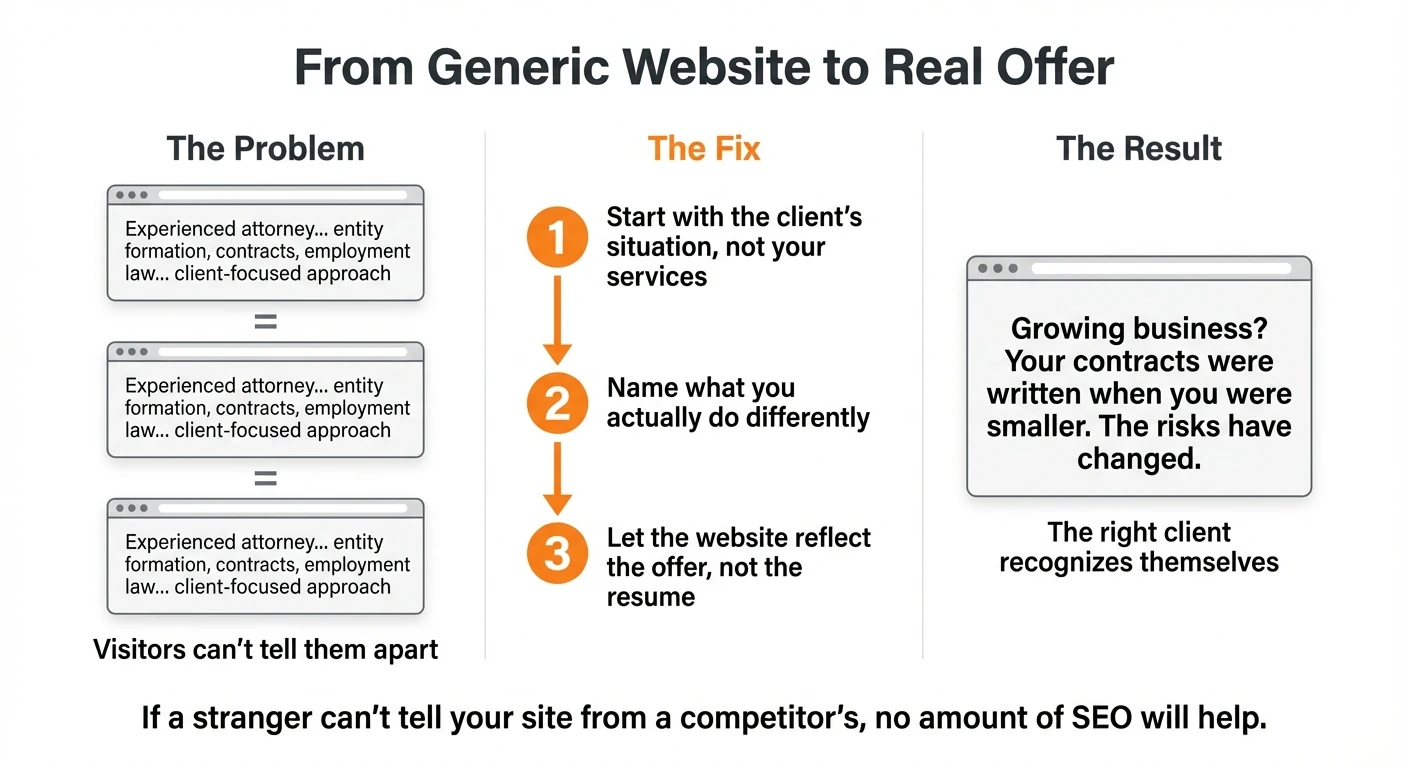
“Experienced business attorney dedicated to helping small businesses succeed. Practice areas: entity formation, contracts, employment law, commercial real estate, mergers and acquisitions. Client-focused approach. Personalized service.”
Here is what she sees on the next tab:
“Experienced business attorney committed to helping small businesses grow. Practice areas: entity formation, contracts, employment law, commercial leasing, business transactions. We take the time to understand your business.”
And the next one:
“Trusted business attorney serving small and mid-size companies. Practice areas: business formation, contract drafting and review, employment matters, real estate, M&A. Your success is our priority.”
She cannot tell them apart. They all say the same thing. They all list the same services. They all claim to be experienced, dedicated, and client-focused. None of them give her a reason to pick one over the others.
So she does what any reasonable person does when the options all look the same: she picks the most convenient one, or the cheapest one, or she puts it off and asks a friend for a recommendation instead.
David’s website does not have a design problem. It does not have an SEO problem. It does not have a conversion optimization problem. It has an offer problem. His site describes what he does without ever telling a potential client why it matters to them specifically.
The Race to the Bottom
When every competitor says the same thing, the only remaining differentiators are price and convenience. This is what a race to the bottom looks like. Nobody chose it. Nobody wants it. But it is the natural result of an entire industry describing itself in identical terms.
David feels this pressure without being able to name it. The inquiries he does get are price-sensitive. They want to know what an LLC costs, not what a long-term legal relationship looks like. He is competing on a playing field where the only visible differences are his headshot, his hourly rate, and how close his office is to the freeway.
The race to the bottom is not about bad marketing. It is about the absence of a meaningful offer. When you do not give people a reason to choose you, they default to the easiest comparison available: price.
What an Offer Actually Is
An offer is not a list of services. It is not a tagline. It is a specific answer to a specific problem that a specific kind of client has, stated clearly enough that the right person reads it and thinks, “That is exactly what I need.”
David’s best clients are owners of growing businesses, companies with 10 to 50 employees that are hitting the stage where handshake agreements and boilerplate contracts start creating real risk. These owners are not looking for the cheapest attorney. They are looking for someone who understands what it feels like to run a growing company, where every legal question is tangled up with cash flow, hiring, customer relationships, and the owner’s personal liability.
These owners have a problem that David solves better than most attorneys, but his website does not mention it. His site says “contracts” when what his best clients actually need is someone who can look at their supplier agreements and say, “This clause will cost you six figures if your biggest customer changes their payment terms.” His site says “employment law” when what his clients need is a phone call before they fire someone, not a lawsuit after.
The gap between what David does and what his website says is where the phone calls are getting lost.
Building a Real Offer
Here is what it looks like to fix this. The process has three parts.
Start with the client, not with yourself. David needs to stop describing his practice areas and start describing his client’s situation. Who are the people he does his best work for? What are they dealing with when they start looking for an attorney? What keeps them up at night? What has gone wrong (or is about to go wrong) that makes legal help feel urgent?
For David’s best clients, the answers are things like: “We signed a contract two years ago that seemed fine, and now our biggest vendor is using a clause we did not fully understand to squeeze our margins.” Or: “We want to bring on a partner, but we do not know how to structure it so that we are protected if it does not work out.” Or: “We are growing fast and I am personally guaranteeing debt that I do not fully understand.”
These are not practice areas. These are situations. And when someone is in one of these situations and they land on a website that describes it accurately, the response is immediate recognition: “This person understands my problem.”
Name what you actually do differently. Every attorney says they are “experienced” and “client-focused.” Those words have lost all meaning. David needs to name the specific thing he does that his competitors do not.
Maybe it is this: David reviews every client’s key contracts annually, not when a problem arises, but before one does. He calls it a legal health check (or whatever plain language fits). Most small business attorneys are reactive. They wait for the phone to ring. David is proactive. That is a real difference, and it is worth stating plainly.
Or maybe it is this: David gives his ongoing clients his cell phone number. When they are about to sign something, about to fire someone, about to shake hands on a deal, they can call him before they commit, not after. That is different from how most attorneys operate, and it is enormously valuable to a business owner who has been burned by acting first and lawyering second.
Whatever the specific differentiator is, it needs to be concrete and specific. Not “personalized service.” That means nothing. The specific thing that David’s best clients would describe if someone asked them why they stay with him.
Let the website reflect the offer, not the resume. Once David knows his offer, the website almost rewrites itself. The homepage does not open with credentials. It opens with a description of the client’s problem: “Your business is growing. Your contracts were written when you were smaller. The risks have changed, and the paperwork has not caught up.”
The services page does not list practice areas. It describes scenarios: “Before you sign that lease.” “Before you bring on a partner.” “Before that vendor contract auto-renews.” Each one links to a clear next step.
The about page does not lead with “J.D. from…” It leads with why David started this practice: because he watched small business owners get hurt by legal problems they could have prevented, and he wanted to be the phone call before the mistake, not the cleanup after.
This is not clever copywriting. It is clarity about who you serve and what you actually offer them.
The Test
How do you know if your offer is strong enough? There is a simple test.
Show your website to someone who has never seen it, alongside two or three competitor sites. Ask them: “Based on what you see, why would you call this one instead of the others?” If they cannot answer the question, your offer is not visible yet. If they say “It seems more professional” or “The design is nicer,” those are weak signals. You want them to say something about the substance: “This one seems like they actually understand my situation” or “This one offers something the others don’t.”
If you cannot pass that test, no amount of SEO, blog posts, testimonials, or chat widgets will solve the conversion problem. The same applies to GEO (Generative Engine Optimization, which is the practice of structuring content so that AI systems like ChatGPT and Perplexity surface it in their answers). GEO can get your content cited by AI, but if the content says the same thing as everyone else, the citation does not help. You are optimizing a message that does not differentiate.
Why This Matters Beyond the Website
The offer problem does not live only on the website. It shows up in every conversation, every networking event, every referral request. When someone asks David what he does, he says “I’m a business attorney for small companies.” That is a category, not an offer. It invites the response, “Oh, I know someone who does that too.”
If instead he says, “I work with growing businesses to find the legal risks they don’t see coming, before those risks become expensive problems,” that is different. It is specific. It describes a problem and a solution. It gives the listener something to remember and repeat.
The website is just the most visible surface where the offer problem shows up. Fixing the offer fixes the website, the elevator pitch, the referral conversation, and the networking introduction all at once. They are all expressions of the same underlying question: what do you do for people that they cannot easily get somewhere else?
Going Deeper
The idea behind this, building an offer so compelling that a customer would feel foolish saying no, comes from a concept Eli Goldratt called the “mafia offer” in his Theory of Constraints methodology. Not because it involves coercion, but because it is an offer so clearly aligned with the customer’s real problem that refusing it would be irrational. The term is playful, but the method is rigorous: identify the customer’s core frustration, find the hidden conflict that the industry has accepted as normal, and design a solution that resolves it.
At Common Sense Systems, we have built a structured process for helping businesses develop this kind of offer. It starts with understanding what your best clients actually value (which is rarely what your website currently says) and works through to an offer statement and a website that reflects it. If David’s situation sounds familiar and you want to explore what a stronger offer looks like for your business, reach me at john@common-sense.com.