When Your Business Is Full But Something Is Missing
You built a practice around work you love. Now it is full, and somehow that is the problem. A guide for wellness practitioners who want their business to work better without losing what made it worth building.
TL;DR
A full schedule is not the same as a thriving practice. When every hour is booked but satisfaction is dropping, the problem is usually not capacity. It is that something in the business is consuming the resources (time, energy, attention) that should be going toward the work that matters most. Find that one thing, address it, and both the business and the practitioner get better.
Lori is a licensed massage therapist, three years into running her own practice. She is good at what she does. Her schedule is full. She has a waitlist. By most measures, the business is working.
But Lori is tired in a way that a long weekend does not fix. She is seeing twenty-five clients a week, and by Thursday afternoon her body hurts and her attention is somewhere else. She is spending her Sunday evenings doing bookkeeping, answering emails, and trying to post something on Instagram. She got into this work because she wanted to help people. Now she spends most of her energy managing a machine that does not leave room for the thing she actually cares about.
She has thought about raising her prices. She has thought about hiring someone. She has thought about cutting back her hours. Each option feels like it solves one problem and creates another. Raise prices and she might lose the clients she likes most. Hire someone and now she is managing people instead of doing the work. Cut back hours and the income drops below what she needs.
It feels like a trap. Grow or stay stuck, and neither option is what she wants.
This feeling is not a personal failing. It is a structural problem, and it has a solution.
The Conflict You Cannot See
Most business advice for someone in Lori’s position is about tactics. Raise your rates. Niche down. Build passive income. Automate your booking. Some of that might help, but none of it addresses why she feels stuck. The tactics assume she knows what to fix. She does not. She just knows something is wrong.
Here is what is actually going on. Lori has two things she needs, and they appear to be pulling in opposite directions.
She needs the business to be financially sustainable. That means sufficient revenue, which currently means a full schedule. And she needs the work to be meaningful and sustainable for her body and her spirit. That means presence, depth, and energy for the clients who benefit most from what she does.
The conflict: to keep the revenue up, she fills every slot. To keep the meaning up, she needs fewer, deeper sessions with more space around them. She cannot do both. Or at least that is how it feels.
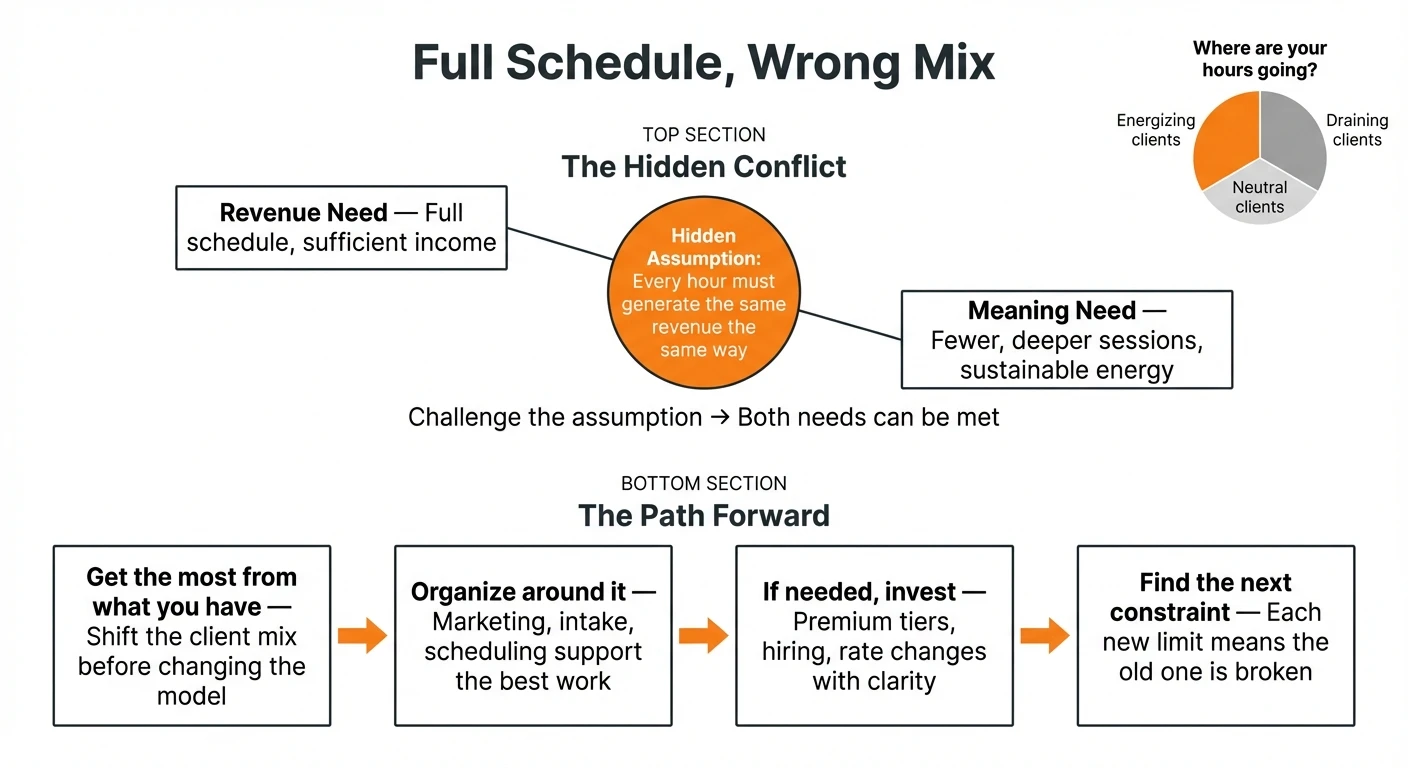
The reason it feels impossible is that there is a hidden assumption buried in the logic. The assumption is: every hour of her schedule has to generate roughly the same revenue in roughly the same way. One hour, one client, one fee.
That assumption is so obvious it is invisible. And once she sees it, the conflict starts to dissolve.
Finding the Real Constraint
Lori’s constraint is not her schedule. Her schedule is full, yes, but full of what? When she actually looks at her client list, a pattern emerges.
About a third of her clients are people she does her best work with. Complex cases, people who are committed to the process, people who come back consistently and refer others. These sessions energize her. They also tend to be the clients who would pay more for longer sessions, add-on services, or specialized work if she offered it.
Another third are fine. Regular appointments, good people, straightforward work. They fill the schedule and pay the bills.
The last third are draining. Last-minute bookings. People who cancel frequently. Sessions that feel transactional rather than therapeutic. They pay the same rate as everyone else, but they cost more in energy, no-show gaps, and the invisible tax of doing work that does not feel like her work.
The constraint is not that Lori is out of hours. The constraint is that her best hours are being consumed by work that does not serve the business or the practitioner. She is at capacity, but it is the wrong capacity. The schedule is full, but it is full of the wrong mix.
This is a different problem than “I need more clients” or “I need to charge more.” It is a problem of allocation. And it changes what the solution looks like.
Working the Problem
Once the real constraint is visible, the steps are practical.
Get the most out of what you have. Before changing anything about the business model, Lori can look at her existing schedule and ask: what if the hours I already work were filled with more of the right clients and fewer of the wrong ones? She does not need more hours. She needs better use of the hours she has.
This might mean gradually shifting her most draining clients toward other practitioners in the area (a referral, not a dismissal). It might mean changing her booking policies so that last-minute slots are not available to everyone. It might mean reserving her highest-energy time blocks (mornings, for most bodyworkers) for the clients and session types where she does her best work.
None of this costs money. It costs attention and a few uncomfortable conversations.
Organize everything else around it. Once Lori is protecting her best hours for her best work, the rest of the business should support that. Her marketing should attract the clients she wants more of, not just anyone who needs a massage. Her intake process should screen for fit. Her scheduling system should reflect her energy patterns, not just her availability.
This is where the bookkeeping and Instagram and email pile becomes relevant. Those tasks are not the constraint, but they are consuming the limited recovery time that Lori needs between sessions. Delegating or batching administrative work (even a few hours a week of virtual assistant support) does not directly increase revenue, but it protects the constraint. It gives Lori the margin she needs to show up fully for the sessions that matter.
If needed, invest. Only after the first two steps are working should Lori consider bigger changes. Maybe that means creating a premium service tier for her most engaged clients: longer sessions, specialized modalities, a treatment plan with follow-up. Maybe it means bringing on another practitioner to handle the general-schedule clients while Lori focuses on the work only she can do. Maybe it means raising rates, but specifically on the services where demand exceeds her available slots.
Each of these investments makes sense only because the constraint is now clear. Without that clarity, raising prices is a guess. Hiring is a risk. A premium tier is a gimmick. With that clarity, each one is a targeted decision that supports the thing that actually matters.
When it works, find the next constraint. If Lori successfully shifts her practice toward higher-value, higher-satisfaction work, the constraint will move. Maybe it becomes marketing (she needs a steady pipeline of the right kind of client). Maybe it becomes her own skill development (she wants to offer more specialized services). Maybe it becomes space (she needs a better treatment room for the premium work). Each new constraint is a sign of progress, not a new problem. It means the old limit has been broken and the system is ready to grow again.
The Assumption That Changes Everything
Go back to the conflict. Lori needed revenue (full schedule) and she needed meaning (fewer, deeper sessions). Those felt like opposites.
The hidden assumption was that every hour had to work the same way: one client, one session, one fee. Once that assumption is visible, alternatives appear. A two-hour deep-tissue session with a committed client at a premium rate generates more revenue than two one-hour general sessions, and it costs less in energy. A monthly treatment plan with four sessions prepaid generates more predictable revenue than four separate bookings, and it builds the kind of client relationship that sustains the practitioner.
The conflict was real, but it was not permanent. It was held in place by an assumption about how the business had to work. Challenge the assumption, and both needs can be met.
This pattern shows up in every small business I have worked with over thirty years. The details change. The structure does not. There is always a conflict that feels unresolvable, and there is always at least one assumption holding it in place that, once surfaced, opens a path forward.
What This Is Really About
Lori did not get into massage therapy to run a business. She got into it because the work itself matters to her. The business is supposed to be the vehicle, not the destination.
When the vehicle starts consuming all the fuel, something has gone wrong structurally. The answer is not to push harder or to lower your expectations. The answer is to find the one thing in the structure that is creating the problem and change it.
That might be the client mix. It might be the pricing model. It might be the way administrative work eats into recovery time. It might be a policy or habit that made sense two years ago and does not anymore. Whatever it is, it is almost always one thing, and finding it changes more than you expect.
If something in this resonated and you want to think through what it looks like for your specific practice, I am happy to have that conversation. Reach me at john@common-sense.com.